Free shipping · 0% for 6 months · White-glove available


Victorian Dining Sets: How to Choose the Right Set

Reviewed by the Mobilia Cleopatra design team
Quick answer: A Victorian dining set pairs a substantial dark-wood table, usually on a carved pedestal or thick turned legs, with upholstered chairs that have carved or balloon-shaped backs. To choose one, measure your room first, pick a table shape and extension system that fits how many people you seat, confirm the wood and upholstery, and then decide whether you also need a buffet or china cabinet. Scale and comfort come before carving.
Victorian dining sets are made for meals that linger: a long table, a full set of chairs, candlelight on polished wood. Most people who want that atmosphere today are not hunting for a fragile antique. They want a new, Victorian-style set with the carving, deep wood tones and upholstered comfort of the period, sized for a modern American home.
This guide explains what makes a dining set Victorian, how its tables, chairs and storage pieces work, which finishes and fabrics suit the look, and how to size and style the room. Use it as a checklist on any set.
What Makes a Dining Set Victorian?
“Victorian” describes furniture from the reign of Queen Victoria (1837 to 1901), and it is less a single style than a family of revival styles. Gothic Revival, Rococo Revival, Renaissance Revival and the later Eastlake and Aesthetic designs all count as Victorian, and each treated the dining room a little differently. If you want the full timeline, our guide to early, mid and late Victorian furniture styles walks through each phase. For choosing a dining set, a handful of shared traits matter most.
- Weight and presence. Victorian tables are solid and generously proportioned. The base is meant to be seen, not hidden under a tablecloth.
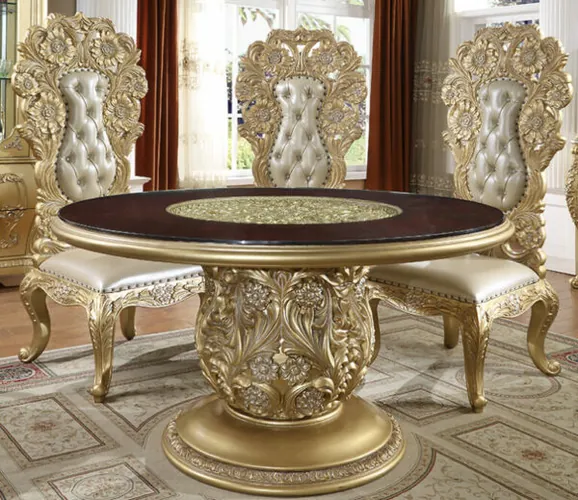
- Carved or turned supports. Expect a carved central pedestal, often splitting into three or four scrolled or claw-style feet, or four thick turned legs with bulbous, vase-like shapes.
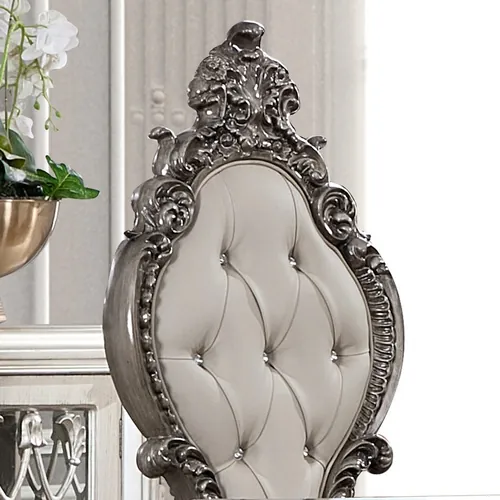
- Shaped chair backs. The balloon-back chair, with its rounded, open back, is the classic Victorian dining chair. Heavier carved crest rails and tall upholstered backs appear in grander sets.
- Dark, warm woods. Mahogany, walnut and rosewood tones dominate, with oak more common in later, plainer pieces.
- Upholstered seats. Padded seats in velvet, damask, brocade or leather, often finished with tufting or nailheads.
- Ornament from nature. Carved flowers, leaves, fruit, scrolls and shells on aprons, crests and feet.
French Louis XV and Rococo sets are lighter and curvier, while Baroque pieces are heavier and more sculptural. A Victorian set usually sits between them: substantial and dark, but softened by padded chairs and floral carving.
The Victorian Dining Table: Shapes, Bases and Extensions
The table sets the scale of the whole room, so choose it before anything else. Victorian makers produced three main shapes, and each solves a different problem.
Rectangular tables
The most common Victorian form is a long rectangle, often with rounded or “D-shaped” ends that soften the corners. It suits a long, narrow dining room and seats the most people for its width. Rectangular tables on four turned legs are the most traditional look, but check where the legs fall: a leg at each corner can leave the end diners with their knees against wood.
Round and oval tables
Round and oval Victorian tables usually stand on a single carved pedestal. This is a practical advantage, because there are no legs to work around and every chair can slide in at any point. A round pedestal table is the easiest way to bring the style into a square room or a smaller dining area. An oval table gives you some of that flexibility with more seating, and its curved edge helps traffic flow around a heavy piece.
Extension systems
Many Victorian tables were built to grow. Period examples used extra leaves inserted into the center, sometimes opened with a crank or a sliding frame, so a family table could stretch for holiday dinners. Modern Victorian-style tables often keep the idea with one or two removable leaves. If you host a few large meals a year, an extendable table lets you keep the room comfortable most of the time and expand only when you need to. Ask where the leaves are stored and whether their finish matches the main top.
You can browse current shapes and bases in our Victorian dining tables collection, which is useful if you want to buy the table first and add chairs later.
Victorian Dining Chairs: Balloon Backs, Carvers and Upholstered Seats
Chairs are where you spend the most time, and where a Victorian set either feels luxurious or uncomfortable. Three chair types define the style.
Balloon-back side chairs have a rounded, open back that resembles an inflated balloon, often with a carved or pierced rail across the middle. They are lighter-looking than most Victorian furniture, which makes them a good choice when the table is heavy. Carved crest chairs have a solid or upholstered back topped with a carved crest rail of scrolls, leaves or flowers. They look grander and suit larger rooms. Armchairs, sometimes called carvers, sit at the head and foot of the table. They are wider, often with scrolled arms, and they anchor the set visually.
Most sets combine two armchairs with four or six side chairs. When you compare chairs, check four things:
- Back height. Tall carved backs are dramatic, but if the room has a low ceiling or a window behind the table, they can block light and feel heavy.
- Arm height. Armchairs should slide at least partly under the table apron. If the arms hit the table edge, the chair will always stand out from the table.
- Seat depth and padding. A firm, well-padded seat is more comfortable over a long meal than a soft one that sags.
- Weight. Solid carved chairs are heavy. Make sure everyone who uses them can pull them out comfortably, especially on a rug.
If you are replacing chairs only, our Victorian-style dining chairs can be paired with an existing traditional table in a similar wood tone.
Buffets, Sideboards and China Cabinets
The Victorian dining room was a room of display. Beyond the table and chairs, the sideboard was its most important piece: a long cabinet for serving, storing linens and silver, and showing off china. Mid-century Victorian sideboards were often massive, with carved backboards, mirrors and shelves. Later in the period, reformers pushed for plainer, more honest construction. The Victoria and Albert Museum holds an oak sideboard closely based on a design in Charles Eastlake’s book Hints on Household Taste, first published in 1868, which combines storage with serving space and open upper shelves for displaying china. You can see the Eastlake-style sideboard in the V&A collection.
For a modern home, you rarely need every storage piece. Think about what you actually store and serve:
- Buffet or sideboard. The most useful addition. It gives you a serving surface for buffet-style meals and closed storage for table linens and serveware. Look at our Victorian buffets if you want one that matches a set.
- China cabinet or curio. Glass doors and interior shelves for displaying fine china, crystal or collected pieces. It adds height, which balances a long low table, but it needs wall space and depth.
- Both. Only in a large room. In a standard dining room, a buffet plus a china cabinet in full carved style can crowd the space and compete with the table.
The storage piece does not have to match the set exactly. Matching the wood tone and the level of ornament is usually enough. A slightly simpler buffet lets a carved table remain the focal point.
Woods, Finishes and Upholstery
Finish and fabric decide whether a Victorian-style set looks rich or theatrical, so it is worth slowing down here.
Wood tones and finishes
Traditional Victorian dining furniture leans dark: deep mahogany reds, walnut browns and the near-black of rosewood. Lighter oak and burr walnut appear in later pieces. In new Victorian-style furniture, you will also see cherry finishes, antique gold or bronze highlights on the carving, and painted finishes with gilded details. Gold works best as an accent that picks out carving, not as a coating over every surface. Always ask what the frame is made of, whether solid wood, veneer over an engineered core, or a composite, and what the finish is. Each can be a sensible choice, but you should know what you are paying for. Our guide to choosing a dining room set covers construction checks in more depth.
Tabletops
A polished wood top is the most traditional choice and shows off the grain. Some Victorian-style tables use inlay, marquetry-style patterns or decorative finishes on the top. Whatever you choose, a high-gloss finish shows fingerprints and water marks more readily, so plan on placemats or a table pad for everyday meals.
Upholstery
Velvet, damask and brocade are the classic Victorian fabrics, in jewel tones such as burgundy, emerald, sapphire and gold, or softer cream and beige. Leather and faux leather give a more library-like look and are easier to wipe clean. If the room is used every night, a tightly woven or performance fabric is the practical choice, while a delicate silk-look damask suits a formal room used for occasions. Check that tufting buttons are secured through the seat and that nailheads run in a straight, even line. For day-to-day upkeep, see our advice on caring for a dining room set.
Sizing a Victorian Dining Set for Your Room
Victorian furniture is substantial, so sizing mistakes are more noticeable than with a slim modern set. These widely used rules of thumb will help you check fit before you order:
- Allow about 24 inches of table edge per diner. Carved armchairs are wider than side chairs, so give the head and foot a little more.
- Leave about 36 inches between the table edge and the wall or other furniture so chairs can pull out. Where people need to walk behind seated guests, plan for more.
- Remember the depth of storage pieces. A buffet or china cabinet reduces the clearance on that side of the table, so measure from the front of the cabinet, not the wall.
- Size the rug generously. A dining rug should extend far enough beyond the table that chair legs stay on it when pulled out, often around 24 inches on each side.
- Check the extended length, too. If the table has leaves, make sure the room works at full length, not just closed.
Mark the table outline on the floor with painter’s tape and set a chair at each position. A carved pedestal table also has a wide base, so check that diners’ feet are not crowded by the feet of the pedestal. If a standard size does not fit your room, a made-to-measure table or set is worth considering before you settle for one that is too large.
How to Choose a Victorian Dining Set
With the style, pieces and sizing in mind, work through these decisions in order:
- Count your real seating. Plan for the number of people you seat every week, then decide whether an extension leaf covers holidays. A seven-piece set (table and six chairs) suits most families; a nine-piece set seats eight.
- Choose the shape for your room. Rectangular for long rooms and larger groups, round or oval on a pedestal for square rooms and easier movement.
- Pick a level of ornament. A fully carved, gilded set is a statement. A set with carved legs and simpler chairs is easier to live with every day and to combine with the rest of the house.
- Confirm materials and finish. Know the frame material, the finish and the upholstery before comparing prices.
- Sit in the chairs if you can. Comfort over a two-hour meal matters more than the crest.
- Decide on storage last. Add a buffet or china cabinet once the table and chairs fit comfortably.
Choosing from our Victorian dining collection
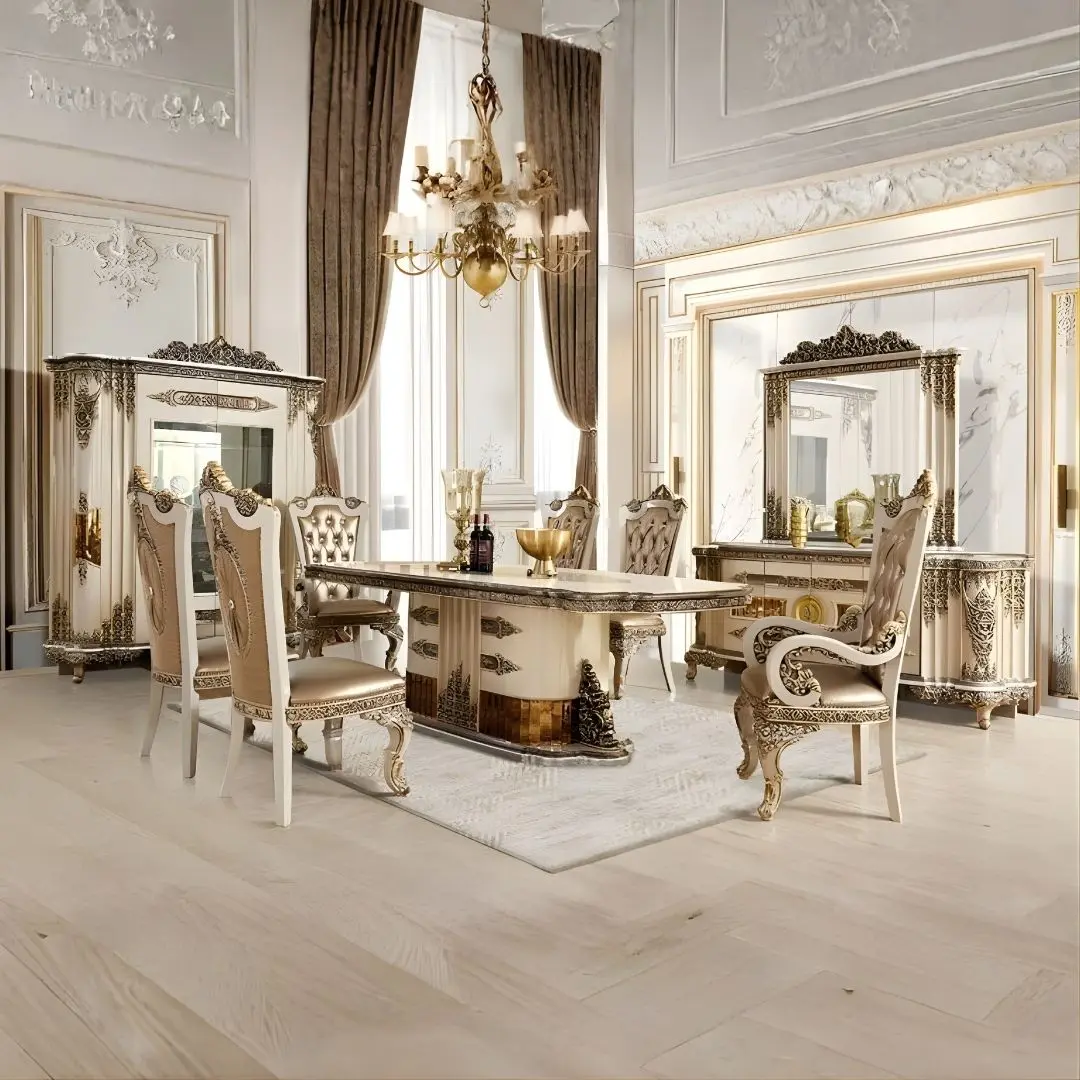
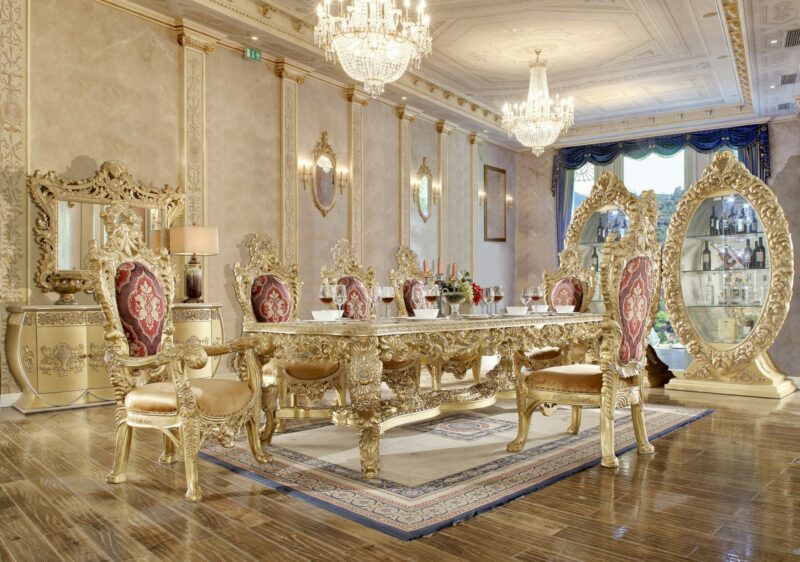
Our Victorian dining sets include new pieces from name-brand vendors and from our own Kleopatra Kingdom line. Vendor sets from Homey Design are factory-made, Victorian-inspired designs. For example, the Homey Design HD-5138 seven-piece set seats six and pairs a rectangular pedestal table with a mother-of-pearl finish, cherry inlay and gold trim, an extendable top listed at 94.5 to 126 inches, and composite wood construction; it was listed at about $7,700 as of October 2026. The HD-1801 seven-piece set combines a metallic antique gold finish with carved, leather-upholstered chairs.
The Kleopatra Kingdom collection is our own handmade line. Nearly every piece is built from solid wood, finished in tones from warm gold and bronze to champagne, ivory and classic brown, with carved frames and gilded accents, and every item can be custom-made to your size, wood finish and upholstery. Its nine-piece dining sets for eight include the Lotus Brown set, listed at about $9,900 as of October 2026. If nothing in stock matches your room, you can also design your own furniture with our team. To talk through options, call (909) 999-1442.
Styling a Victorian Dining Room
A Victorian dining set looks its best in a room that supports it without turning into a period stage set. A few principles keep the result elegant:
Use rich but controlled color. Deep wall colors such as burgundy, forest green, navy or warm taupe flatter dark wood, especially in rooms used mostly in the evening. In a bright, open-plan home, a warm neutral wall with one rich color in the upholstery or curtains keeps the set from feeling heavy.
Add architectural detail where the house allows it. Wainscoting, a chair rail, crown molding or patterned wallpaper above a painted lower wall all echo the layered look of a Victorian room. Where those are not possible, a large framed mirror or a pair of framed prints does a similar job.
Layer the lighting. A chandelier centered over the table is the traditional focus, in brass, crystal or antique gold. Wall sconces or candlesticks on the buffet add the warm, low light that makes polished wood glow. Put the chandelier on a dimmer.
Edit the accessories. Victorian rooms were famously full, but a modern version reads better with fewer, larger pieces. Let one or two statement items, usually the table and a mirror or china cabinet, carry the room.
Connect it to nearby rooms. Repeat the wood tone or one fabric color in an adjoining living room so the house feels related, without carving every piece. Our Victorian style furniture collection covers living room and bedroom pieces if you want to carry the look further.
Frequently Asked Questions
What is a Victorian dining room set?
A Victorian dining room set is a matching table and chairs, sometimes with a buffet or china cabinet, in the style of 1837 to 1901. It typically has a substantial dark-wood table on a carved pedestal or turned legs, upholstered chairs with carved or balloon-shaped backs, and ornament such as scrolls, flowers and leaves. Most sets sold today are new Victorian-style reproductions rather than antiques.
What does a balloon-back chair look like?
A balloon-back chair has a rounded, open back that curves inward at the waist, like the outline of an inflated balloon. It often has a carved or pierced rail across the middle and an upholstered seat. It is one of the most recognizable Victorian dining chair designs.
How many chairs come with a Victorian dining set?
Most sets come as a seven-piece set (a table with two armchairs and four side chairs, seating six) or a nine-piece set (seating eight). Choose based on the number of people you seat regularly and whether the table extends.
Do I need a matching buffet or china cabinet?
No. A buffet is useful for serving and storage, and a china cabinet adds height and display space, but neither is required. If you add one, match the wood tone and level of carving rather than buying an identical piece for every wall.
Can a Victorian dining set work in a modern home?
Yes. Pair a carved set with calm walls, a simple rug and one statement light, and keep accessories edited. A Victorian table with slightly simpler chairs, or a set in a lighter finish, blends more easily with contemporary rooms.
Are Victorian velvet dining chairs practical?
They can be. Velvet will show pressure marks over time, which is part of its character. Vacuum it gently with a soft brush attachment, blot spills right away, and choose a performance velvet if the chairs are used every day.
Should I buy an antique or a new Victorian-style dining set?
An antique offers history but may need careful handling, and older chairs may not suit daily use. A new Victorian-style set gives you the look with modern sizing and upholstery. For a valuable antique, ask a professional furniture conservator about its condition and care before using it every day.
Final Thoughts
A Victorian dining set brings warmth and ceremony to a home. The carved pedestal, the shaped chair backs, the dark polished wood and the plush upholstery all say that meals here are meant to be enjoyed slowly. But the best set is the one that fits your room, your guest list and the way you entertain.
Start with measurements and seating, then choose the shape, ornament, finish and fabric. Add storage only once the table and chairs work, and style the room with rich color, layered lighting and few accessories.
When you are ready to compare pieces, browse our Victorian dining sets online or visit our Upland showroom at 280 N Benson Ave, Suite 6, Upland, CA 91786, and ask our team about the materials, finishes and sizes of any set you are considering.