Free shipping · 0% for 6 months · White-glove available


Solid Wood Luxury Furniture: Woods, Construction and Buying Guide

Reviewed by the Mobilia Cleopatra design team
Quick answer: Solid wood luxury furniture is built mainly from boards of natural timber, such as oak, walnut, maple, cherry, mahogany, beech, or ash, rather than from a wood-look surface over a manufactured core. Solid wood can be sanded, refinished, and repaired for decades, but it moves with humidity and costs more. Well-made veneer and plywood are not automatically inferior: they are often the smarter choice for wide tabletops, curved fronts, and decorative grain patterns. The best purchase comes from knowing which material is used where, how the piece is joined, and how it is finished.
Shopping for wood furniture can be confusing. Product listings use phrases like “solid wood,” “wood veneer,” “all-wood construction,” and “wood finish,” and they do not mean the same thing. Two dressers that look almost identical in a photo can be built in completely different ways, and that difference shows up years later in how they wear, how they can be repaired, and how they hold their value.
This guide explains the materials behind wood furniture in plain terms. You will learn the honest pros and cons of solid wood, veneer, plywood, MDF, and particleboard; how the most common furniture hardwoods differ in color, grain, and hardness; how to check whether a piece is solid wood; which finishes protect it; how to care for it; and what actually drives the price. If you are working with a specific style, our companion guides go deeper: see the woods traditionally used in French style furniture and the role of mahogany in Victorian furniture.
What Solid Wood Luxury Furniture Really Means
In furniture, “solid wood” means that the visible parts of a piece, such as the top, legs, frame, drawer fronts, and rails, are cut from lumber rather than from a sheet product with a thin wood layer on the surface. A solid oak table top, for example, is usually several oak boards glued edge to edge. If you could cut it in half, you would see oak all the way through.
Very few pieces are 100 percent solid wood in every component. Many high-quality cabinets use plywood for back panels or drawer bottoms, because a thin plywood panel stays flat and does not split. Some solid wood case pieces also carry veneered panels on doors or sides to show off a figured grain. That mix is normal. What matters is that the parts that carry weight and take daily wear are built from material that suits the job.
The word “luxury” adds expectations beyond the wood itself: careful joinery, a well-applied finish, balanced proportions, and, in traditional styles, details like carving, molding, and gilding. Solid wood makes carving possible, since a thin veneer cannot be carved deeply, which is one reason ornate traditional furniture leans so heavily on solid timber.

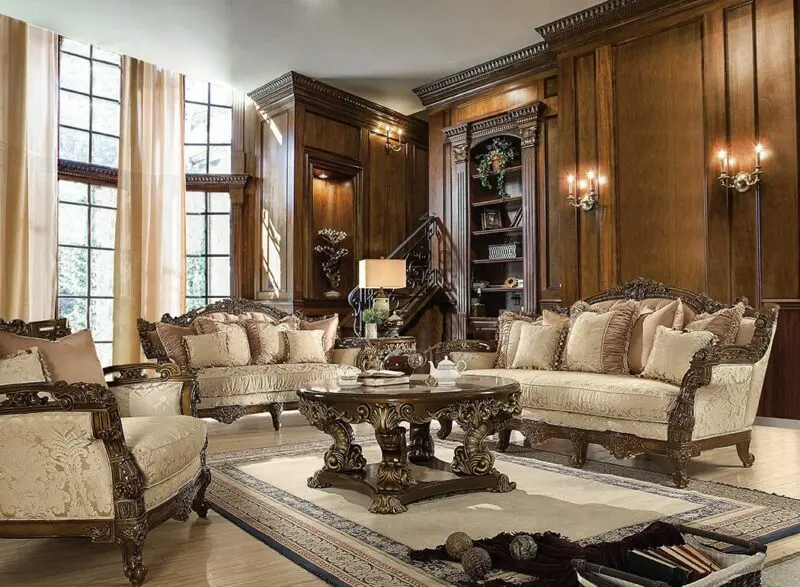
Premium solid wood luxury furniture combining elegance
Solid Wood vs. Veneer vs. Engineered Wood
Each material has real strengths. The table below summarizes the trade-offs, and the sections after it explain them.
| Material | What it is | Main strengths | Main weaknesses |
|---|---|---|---|
| Solid wood | Boards cut from timber | Can be sanded and refinished many times; strong joinery; can be carved | Moves with humidity; heavier; higher cost |
| Veneer | Thin sheet of real wood bonded to a core | Stable panels; matched or figured grain; less costly figured wood | Limited sanding; chips or lifted edges need skilled repair |
| Plywood | Cross-laminated wood layers | Strong, stable, holds screws well | Exposed edges need banding or trim |
| MDF | Fine wood fibers pressed with resin | Very flat, smooth; ideal for paint and veneer | Heavy; swells if wet; can sag over long spans |
| Particleboard | Wood particles pressed with resin | Lowest cost | Weakest at screws and joints; damaged by water |
Solid wood
The biggest advantage of solid wood is longevity through repair. Scratches, dents, and worn finish can be sanded out and refinished, often more than once over a lifetime. Joints can be re-glued. The trade-off is movement: wood absorbs and releases moisture, so wide solid panels expand and contract across the grain through the seasons. Good makers design for this with floating panels and fasteners that allow movement. Poorly designed solid wood pieces can crack or warp.
Veneer
Veneer has an undeserved reputation. It is real wood, sliced thin and bonded to a stable core, and it has been used on fine furniture for centuries, especially for matched grain patterns and marquetry. Because the core does not move much, veneered panels stay flat in places where a wide solid panel might cup. The limits are practical: veneer can only be sanded lightly, and chipped edges or lifted sections need careful repair. The quality depends on the core and the craftsmanship, not on the word “veneer” itself.
Plywood, MDF, and particleboard
Plywood is built from thin layers glued with the grain alternating, which makes it strong and stable; it is common in quality cabinet backs, drawer bottoms, and sofa frames. MDF is dense and smooth, which makes it an excellent base for paint or veneer, but it is heavy and does not tolerate water. Particleboard is the budget option and works best in light-duty pieces. None of these is “fake,” but they are not interchangeable with solid wood in structural parts that take repeated stress.

Custom luxury furniture crafted from solid wood
Common Hardwoods in Luxury Furniture and How They Differ
Species affects color, grain, hardness, how a piece takes stain, and how it ages. These are general characteristics; individual boards vary, and finish color can make one species look like another.
Oak
Oak is strong and heavy, with an open, prominent grain. Red oak has a slightly pink cast, while white oak is more golden-brown. Quartersawn oak shows distinctive ray “flecks.” Oak suits dining tables, case goods, and traditional pieces that need to handle daily use.
Walnut
American black walnut is prized for its rich chocolate-brown heartwood and flowing grain. It is moderately hard, works and carves well, and looks refined with a simple oil or clear finish. It is usually priced above oak and maple.
Maple
Hard maple is dense and very hard, with a fine, tight grain and pale color. It resists dents well, which is why it appears in tables and drawer parts. It can blotch when stained dark unless the finisher prepares it carefully.
Cherry
Cherry has a smooth, fine grain and a warm color that darkens noticeably with exposure to light over time. It is softer than oak or maple, so it shows dents more readily, but many owners value the deep patina it develops.
Mahogany
Genuine mahogany has a reddish-brown color, an even texture, and a reputation for stability and workability, which made it a favorite for carved and formal furniture. In the USDA Forest Products Laboratory’s shrinkage tables, true mahogany shrinks noticeably less than species such as American beech or sugar maple. Be aware that “mahogany finish” describes a color, not a species.
Beech
Beech is hard, strong, and fine-grained, with a pale, even tone. It bends well and takes carving and finishes evenly, so it is widely used for chair frames and painted or gilded traditional furniture. It is also one of the woods that moves more with humidity, so construction and finish matter.
Ash
Ash is tough and shock-resistant, with a bold, open grain similar to oak and a lighter color. It bends well and is used for chairs and frames, as well as contemporary pieces with a natural finish.

solid wood luxury furniture designed for refined luxury interiors
How to Tell If Furniture Is Solid Wood
No single test is conclusive, so combine several checks. These are the quickest ones to do in a showroom or when a piece arrives.
- Look at the edges and ends. On solid wood, the grain on the top continues over the edge, and the end grain at the board ends matches the face. A thin line at the edge, or a grain pattern that suddenly stops, points to veneer or edge banding.
- Compare the top and underside. Unfinished wood underneath with a grain that matches the top suggests solid wood. A smooth, uniform underside often means MDF or particleboard.
- Check for repeating grain. Real boards vary. A pattern that repeats exactly across several panels is often a printed laminate, not wood at all.
- Look at carving. Deep carving needs solid material, although carved parts can be attached to a veneered body.
- Open drawers and doors. Examine drawer sides, backs, and the inside of doors. Exposed edges reveal the core.
- Consider weight carefully. Solid hardwood is heavy, but MDF is heavy too, so weight alone proves little.
- Read the specifications. Look for wording such as “solid wood” versus “wood veneer,” “engineered wood,” or “wood finish,” and ask which parts each term applies to.
Construction tells you as much as material. Our guide on how to identify high-quality furniture covers joinery, drawer construction, and frames in detail, so we will not repeat it here.

Artisan-made solid wood luxury furniture
Wood Finishes: What Protects the Surface
The finish decides how a wood piece looks and how well it stands up to spills, heat, and wear. It also decides how you should clean it.
- Oil finishes soak into the wood and leave a natural, low-sheen look. They are easy to refresh but offer limited protection against water and heat.
- Wax gives a soft glow and a pleasant feel, usually over another finish. It needs occasional reapplication and is not a strong barrier on its own.
- Shellac and French polish produce a warm, deep shine associated with traditional furniture. They are sensitive to alcohol, heat, and water marks.
- Lacquer is common on factory and high-end furniture. It dries fast, builds a clear film, and can be repaired by skilled finishers.
- Varnish, polyurethane, and conversion finishes form tougher films that resist moisture and wear, which suits dining tables and other heavy-use surfaces.
- Paint and gilding are typical on French, Rococo, and Neoclassical styles. Gilded and painted surfaces need gentle dusting and should not be rubbed with cleaners.
Stain changes color but not protection. A walnut-color stain on a lighter wood is common and perfectly legitimate, as long as the listing is honest about the species underneath.
Caring for Solid Wood Furniture
Wood is hygroscopic: it takes on and gives off moisture depending on the humidity and temperature of the surrounding air, according to the USDA Forest Products Laboratory’s Wood Handbook. The handbook also explains that wood shrinks and swells most along the growth rings, about half as much across them, and very little along the grain. That is why wide tabletops and panels are the parts most likely to show movement.
A few widely accepted habits keep solid wood looking its best:
- Dust regularly with a soft, dry, or slightly damp cloth, and dry the surface right away.
- Avoid excess water, harsh household cleaners, and silicone sprays unless the maker recommends them.
- Test any cleaner or polish in a hidden spot first.
- Use coasters, placemats, and trivets; heat and moisture cause most finish damage.
- Keep pieces away from heating vents, fireplaces, and direct afternoon sun, which can dry wood and fade or darken the finish unevenly.
- Keep indoor humidity reasonably stable through the seasons.
- Lift pieces to move them instead of dragging them, which strains joints.
For dining furniture specifically, see our guide on caring for a dining room set. For a valuable antique, consult a professional conservator before cleaning or refinishing.
What Drives the Cost of Solid Wood Furniture
Two solid wood pieces of similar size can be priced very differently. These are the main reasons.
- Species and grade. Walnut, cherry, and genuine mahogany usually cost more than oak, maple, or beech. Clear, well-figured boards cost more than boards with knots and color variation.
- How much solid wood is used. Solid tops, frames, and drawer fronts cost more than solid trim on a veneered body.
- Thickness and size. Thicker tops, large dining tables, and tall case pieces use more lumber and more labor.
- Drying and preparation. Properly dried lumber that is milled flat and matched for color takes time.
- Joinery. Mortise-and-tenon frames and dovetailed drawers take longer than stapled or screwed joints.
- Carving and ornament. Hand carving, applied molding, and gilding add significant labor, especially in French and Victorian styles.
- Finishing. Multi-step finishes, hand rubbing, and specialty paint or gold-leaf effects add cost.
- Customization. Custom sizes, fabrics, and finishes require individual planning.
Higher price does not guarantee solid wood or good construction, so always check the specifications and the build rather than relying on price alone.
Buying Solid Wood Luxury Furniture With Confidence
Start with how a piece will be used. A dining table that hosts family meals every day benefits from a hard species and a durable film finish. A carved console in a formal entry can favor beauty over toughness. Then confirm the details: which parts are solid wood, which are veneer or engineered wood, what finish is used, and what the care instructions are. Ask the seller to put material details in writing when the listing is unclear.
At Mobilia Cleopatra, materials vary by brand and collection, so we encourage shoppers to read each product’s specifications. Our Kleopatra Kingdom handmade collection is described on its brand page this way: nearly every piece is built from solid wood, with carved frames and gilded accents in finishes from warm gold and bronze to champagne, ivory, and classic brown. The rest of our catalog comes from a range of furniture brands, and construction differs from item to item.
When you compare pieces, browse by room: dining tables are where hardness and finish matter most, coordinated bedroom sets and matching nightstands show how wood tones work together, and console tables are a smaller way to bring carved wood into an entry or living room. If you need a specific size or finish, you can explore custom furniture options. You are also welcome to see pieces in person at our Upland showroom at 280 N Benson Ave, Suite 6, Upland, CA 91786, or call (909) 999-1442 with questions about a specific item.

Bespoke solid wood luxury furniture designed for refined luxury interiors
Frequently Asked Questions
Is solid wood furniture worth the extra cost?
Often, yes, for pieces you plan to keep a long time. Solid wood can be sanded, refinished, and repaired repeatedly, so a well-built piece can last for decades. The value depends on construction and finish as well as the material, so a poorly built solid wood piece is not a better buy than a well-made veneered one.
Is veneer furniture bad?
No. Veneer is real wood bonded to a stable core, and it has been used on fine furniture for centuries. Its panels stay flat and can show matched or figured grain. Its limits are that it can only be sanded lightly and that chips or lifted edges need skilled repair.
What is the best wood for furniture?
It depends on use and look. Oak and hard maple are tough choices for dining tables. Walnut and cherry are prized for color and grain. Mahogany is valued for stability and carving, and beech and ash are strong options for chairs and frames.
How can I tell if furniture is solid wood or veneer?
Check whether the grain on the top continues over the edges and ends, compare the top with the underside, look for repeating patterns, and inspect the inside of drawers and doors. Weight alone is not reliable, because MDF is also heavy. When in doubt, ask for the material of each part in writing.
Is plywood or MDF better for furniture?
Each has its place. Plywood is stronger, holds screws better, and handles structural roles such as frames, backs, and drawer bottoms. MDF is flatter and smoother, which makes it a good base for paint and veneer, but it is heavier and more vulnerable to water.
Does solid wood furniture crack or warp?
It can if it is poorly designed or exposed to big swings in humidity or heat. Wood naturally expands and contracts across its width, so good makers allow for that movement. Keeping pieces away from vents and direct sun and keeping indoor humidity steady reduces the risk.
What does “wood finish” mean on a product listing?
Usually it describes the color or surface appearance, not the material. A “walnut finish” or “mahogany finish” piece may be made of a different wood or of engineered wood with a printed or stained surface. Look for an explicit statement of the materials used.
How do I clean solid wood furniture?
Dust with a soft cloth, wipe spills right away, and avoid soaking the surface or using harsh cleaners. Test any polish in a hidden spot first, follow the maker’s care instructions, and consult a professional conservator for valuable antiques.
Choosing Wood Furniture That Lasts
Solid wood luxury furniture earns its reputation through repairability, strength, and the way natural grain and color age over time. The smartest buyers, though, look past the label. A table built from a hard species with sound joinery and a durable finish will serve better than a costly piece built carelessly, and a well-made veneered cabinet can be a better choice than a poorly designed solid one.
Focus on the details that matter: which parts are solid wood, which species is used, how the piece is joined, and how it is finished and cared for. With those answers in hand, you can choose furniture that suits your home, your daily routine, and your style, from carved traditional pieces to clean-lined modern designs, and enjoy it for many years.
