Free shipping · 0% for 6 months · White-glove available


Standard Sofa Size: Sofa, Loveseat and Sectional Dimensions

Reviewed by the Mobilia Cleopatra design team
Quick answer: A standard sofa is typically about 70 to 90 inches long, 32 to 40 inches deep and 30 to 36 inches tall, with a seat height of roughly 17 to 19 inches. A loveseat is shorter, usually about 50 to 72 inches wide, and a sectional commonly measures about 94 to 156 inches along its long side. There is no official standard, so always check the exact dimensions of the piece you want.
Sofa shopping starts with numbers, yet the numbers rarely line up from one source to the next. One guide calls a three-seat sofa 84 inches, another says 90, and a loveseat can be anything from a compact 52 inches to a generous 72. That is because “standard” in furniture is a habit rather than a rule. Designers and manufacturers cluster around familiar ranges, and those ranges are what this guide gathers in one place.
Below you will find a size chart for sofas, loveseats, apartment sofas and sectionals, a plain-English explanation of length, depth, height and seat measurements, and the two checks that prevent most regrets: measuring the path into your home and leaving enough room to walk around the piece. Every figure is a typical range gathered from several furniture and design sources, so use it to plan, then confirm the exact size on each product page before you decide.
Standard Sofa Size at a Glance
If you only need the headline numbers, this chart brings together the dimensions that show up again and again in furniture and design guides. All figures are in inches and describe overall outside measurements, from one outer edge to the other, not the seating space inside.
| Type | Typical length or width | Typical depth | Typical height |
|---|---|---|---|
| Standard three-seat sofa | 70 to 90 | 32 to 40 | 30 to 36 |
| Loveseat | 50 to 72 | 32 to 38 | 30 to 36 |
| Apartment or compact sofa | 72 or less | 30 to 35 | 30 to 33 |
| Sectional (long side) | 94 to 156 | 34 to 42 | 30 to 36 |
Two more numbers matter for comfort rather than fit: seat height is usually 17 to 19 inches from the floor, and seat depth, the front-to-back space you actually sit on, is usually 20 to 24 inches. We explain both below.
When you browse our sofa collection, expect the same spread. A traditional, rolled-arm design often sits toward the larger end of these ranges, while a sleek modern frame can sit toward the smaller end.
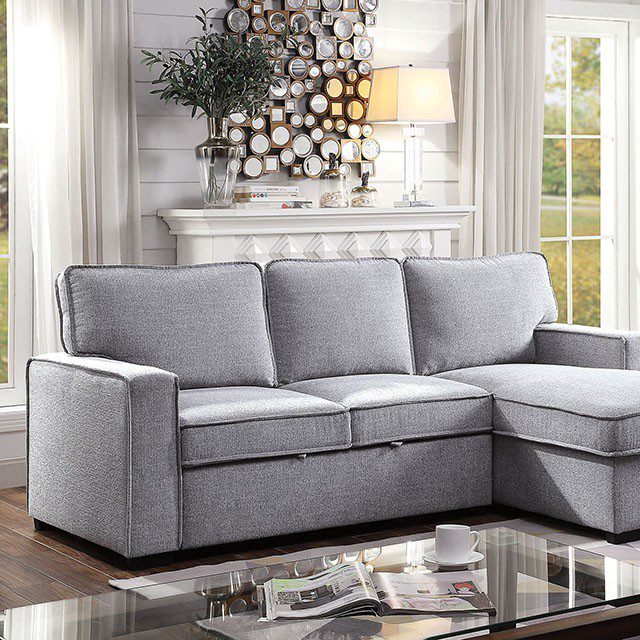
Ines sectional by Furniture of America
Standard Sofa Dimensions Explained
Three outside measurements describe any sofa: length, depth and height. Each tells you something different about how the piece will live in your room.
Length
Length runs from the outer edge of one arm to the outer edge of the other. A three-seat sofa is typically about 70 to 90 inches long, and many guides name 84 inches, or seven feet, as the most common figure. Longer four-seat sofas move toward 90 to 110 inches, which is a big commitment for a typical living room. Length is the number that decides how much wall you need, so it is the first thing to compare with your floor plan.
Depth
Depth is measured front to back at the deepest point, usually from the back of the frame to the front edge of the seat cushions. Most sofas fall between 32 and 40 inches, with about 35 inches the figure most often quoted as average. Depth matters twice: it eats floor space, and it determines whether you can fit the sofa through a door, as the measuring section explains.
Height
Overall height, floor to the top of the back, is typically 30 to 36 inches. A low back feels modern and open, while a taller back with a carved or tufted top feels more formal and gives your head and neck more support. If your sofa will sit in front of a window or under artwork, check that the back height leaves enough room for them.
Arms count too
Arm width is easy to overlook. Each arm can use up roughly 4 to 8 inches of the total length, so two sofas of the same length can have noticeably different seating space. A sofa with slim track arms seats more people than a same-length sofa with wide rolled arms, which is worth knowing before you count seats.
Seat Depth and Seat Height: The Comfort Numbers
Overall size tells you whether a sofa fits the room. Seat measurements tell you whether it fits your body.
Seat height is the distance from the floor to the top of the seat cushion, and guides typically put it at 17 to 19 inches. That is close to the height of a standard dining chair, which is why most adults find it easy to sit down and stand up. Taller people often like the upper end of that range, while anyone with sore knees or hips may prefer a slightly firmer, higher seat that is easier to rise from. A lower, plusher seat looks relaxed but can be harder to get out of.
Seat depth is the front-to-back space of the cushion itself. Typical sofas sit around 20 to 24 inches, which suits upright sitting and conversation. Deep-seat sofas have noticeably more room, which is wonderful for curling up but can leave shorter people with their feet dangling and their back unsupported unless they add a pillow.
Here is a quick test you can do in a showroom or at home with a chair you already own. Sit back fully with your lower back supported. You should have a couple of inches between the back of your knees and the front of the seat, and your feet should rest flat on the floor. If either feels wrong, the overall dimensions will not save you. Seat height and seat depth belong in your measurements as much as length does.
Also think about how you actually use the sofa. A family that watches movies together may value depth and softness, while a household that entertains guests may prefer a firmer, more upright seat. If you are still deciding what the room needs overall, our guide to choosing living room furniture covers layout and style before you get to the tape measure.
Loveseat Size: How Big Is a Loveseat?
A loveseat is a small sofa built for two. Like sofas, loveseats have no single standard size, but most are about 50 to 72 inches wide, measured across the outside of the arms. Bassett notes that some are barely four feet wide while others approach six feet, so the label alone does not tell you much.
It helps to think in three bands.
- Compact loveseats are about 52 to 58 inches wide and sometimes as shallow as 30 inches. They suit bedrooms, offices, entryways and small apartments.
- Standard loveseats are about 58 to 66 inches wide and roughly 34 to 36 inches deep. This is the size most people picture, and it seats two adults comfortably.
- Oversized loveseats run about 66 to 72 inches wide. At that point they are approaching small-sofa territory and can seat two people with room to stretch out.
Loveseats are often used as a pair with a sofa, facing each other across a coffee table, or alone in a room that cannot take a full sofa. They also work well at the foot of a bed or beneath a window. Our loveseat collection shows how widely the style varies, and our explainer on what a loveseat is and how it differs from a sofa goes deeper on the history and use cases.
One practical point: a “loveseat” and a “two-seater sofa” are often the same thing, though some retailers use “loveseat sofa” for the largest sizes. Always compare the actual width, not the name.

Dresden leather sofa with 4 pillows by ACME
Sectional Dimensions: Sizes, Shapes and Depth
Sectionals are the hardest sofas to generalize about because they are sold in so many configurations. A small L-shape may have a long side of about 78 to 94 inches, a standard L-shape about 94 to 120 inches, and a large one anywhere from 120 to 156 inches. The shorter leg of an L is typically between 56 and 94 inches. U-shaped sectionals can be 112 inches wide or more, and modular sectionals are built from individual pieces that are each roughly 28 to 36 inches wide.
Depth for most sectionals sits around 34 to 42 inches, and heights match those of ordinary sofas. With an L-shape, “width” and “depth” refer to the two legs of the L, so read product listings carefully to see which measurement is which. If the chaise is on one end, that end is longer than the rest of the sofa.
Because a sectional uses so much floor, the room matters more than the number of seats. Check that the shape leaves a walkway, that the long side fits against a wall without blocking a vent or door, and that the corner position suits how people will move through the room. If you are comparing finishes, our sectional sofas page is the best place to start. For a color-led search, we have gathered gray sectionals and black sectionals, which look quite different in the same footprint: lighter colors tend to feel airier, while dark ones read as heavier and more formal.
Sleeper sofas deserve a special note. They are usually deeper and heavier than regular sofas, and the bed needs open floor space when unfolded. Check both the folded size and the opened size on the product page, and browse our sleeper sofas if a guest bed is part of the plan.
What Size Sofa for an Apartment or Small Room?
In a small living room, the safest approach is to choose the sofa for the room rather than the room for the sofa. Guides that address small spaces suggest a loveseat or a compact three-seat sofa of roughly 72 inches or less for a room around 10 by 10 feet. Compact three-seat sofas are typically about 72 to 78 inches long and 32 to 35 inches deep, while apartment loveseats can drop to about 52 to 58 inches wide and as little as 30 inches deep.
Several design choices make a sofa feel smaller than its measurements.
- Raised legs let you see floor beneath the sofa, which makes the room feel more open.
- Slim arms save width without reducing seat length.
- Lighter colors reflect more light. A white leather sofa can brighten a compact room, though it shows marks more easily than a darker one.
- A shallower depth keeps the walkway clear, though very shallow seats can feel less comfortable for lounging.
Avoid the temptation to fill every wall. A smaller sofa with a side table and a clear path to the window usually looks more generous than a large sofa jammed in with no breathing room.
How to Measure Your Doorways and Room
This is the step that saves the most grief. A sofa that fits beautifully in the room can still fail to enter the house, and returns on large pieces are rarely simple. Do these checks before you order.
- Mark the final spot. Use painter’s tape on the floor to outline the length and depth. Live with it for a day and walk around it.
- Measure every opening on the route. That includes the front door, any hallway, corners, stairwells, elevators and interior doors. Write down the width and the height of each, and note the narrowest point. Measure the clear opening, not the frame.
- Measure the sofa’s diagonal depth. This is the measurement from the top back corner of the frame to the bottom front of the seat. It is the figure that decides whether a sofa can be tilted through a tight doorway, and manufacturers rarely list it, so measure it yourself on the showroom piece or ask for it.
- Measure the frame, not the cushions. Cushions compress and often come off, so the rigid frame is the true limit.
- Check each piece of a sectional. Sectionals often arrive in several sections, so each section must clear the route, not the assembled sofa.
- Look at the ceiling and the turns. Tight stair landings and low ceilings can be harder than doorways. Do not forget light fixtures and railings.
Compare your tightest opening with the sofa’s smallest dimension. Leave a few inches of margin so that nobody scrapes knuckles or paint. If a piece is a close call, ask about removable legs or arms before you order, and plan the delivery route in advance. Our Upland showroom at 280 N Benson Ave, Suite 6, Upland, CA 91786 is an easy place to see real sofas in person and compare how they feel against your measurements.
If your space is genuinely unusual, size can be a good reason to go custom. Our custom furniture service is the place to ask about pieces made to your measurements.
Walking Clearance and Spacing Around a Sofa
Once you know the sofa fits through the door, make sure it fits the way you live. Furniture needs breathing room, and the common guidelines are simple.
- Main walkways: leave about 30 to 36 inches for the paths people use most. A busy route through a room is more comfortable closer to 36 inches or a little more.
- Around a sectional: at least 30 inches of space around the open sides keeps traffic moving without bumping.
- Sofa to coffee table: about 14 to 18 inches lets you reach your drink and still stand up easily. Some guides allow up to 20 inches.
- Beside the sofa: if one end sits against a wall, a gap of a few inches is fine, but leave more where people will pass.
- Sleeper sofas: plan for the bed to open fully, with room to walk beside it.
Scale matters as much as clearance. A sofa should relate to the room’s other pieces: a coffee table at or just below seat height, a rug large enough that the front legs of the sofa rest on it, and a coffee table roughly two-thirds the sofa’s length. Those details make a room feel pulled together, and they all start from the sofa’s length.
If you are furnishing the whole room, a matched group can take the guesswork out of proportions because the pieces are designed to share a scale. Even then, treat every dimension as something to verify against your own floor plan.
Frequently Asked Questions
What is the standard size of a sofa?
There is no official standard, but a typical three-seat sofa is about 70 to 90 inches long, 32 to 40 inches deep and 30 to 36 inches tall. Many guides name 84 inches as the most common length. Always check the exact dimensions on the product page.
How big is a loveseat?
Most loveseats are about 50 to 72 inches wide, with depths of roughly 32 to 38 inches. Compact versions start near 52 inches, standard ones are around 58 to 66 inches, and oversized ones reach about 72 inches.
What are standard couch dimensions for an apartment?
An apartment-friendly couch is usually a compact three-seater of about 72 to 78 inches or a loveseat of about 52 to 58 inches, with a shallower depth of 30 to 35 inches. Choose slim arms and raised legs to keep the room feeling open.
What are typical sectional dimensions?
A common L-shaped sectional has a long side of about 94 to 120 inches and a short side of about 78 to 94 inches, while larger ones reach 156 inches. Depth is usually 34 to 42 inches. Because configurations vary, measure each piece and the assembled shape.
What is a comfortable sofa seat height and depth?
Seat height is usually 17 to 19 inches from the floor, and seat depth is usually 20 to 24 inches. Deeper seats suit lounging, while shallower, firmer seats are easier to sit up in and to rise from.
How do I know if a sofa will fit through my door?
Measure the width and height of every opening on the route, then measure the sofa’s diagonal depth and its smallest side. If the sofa fits through the narrowest point with a few inches to spare, it should pass. For sectionals, check each separate piece.
How much space should I leave around a sofa?
Leave about 30 to 36 inches for walkways and about 14 to 18 inches between the sofa and the coffee table. For a sectional, keep at least 30 inches free around the open sides.
Is a loveseat smaller than a sofa?
Yes. A loveseat seats two and is usually 50 to 72 inches wide, while a three-seat sofa is usually 70 to 90 inches. Depth and height are often similar, so the main difference is the width.
Choosing the Right Size With Confidence
Standard sofa size comes down to a few reliable ranges: about 70 to 90 inches long, 32 to 40 inches deep and 30 to 36 inches tall for a sofa, shorter for a loveseat, and far more variable for a sectional. Within those ranges, the right choice depends on your room, your doorways and the way you sit.
Measure the floor space, trace the route into the house, leave room to walk, and test the seat for comfort. Then compare real dimensions rather than labels. When you are ready to look, browse our sectionals, sofas and loveseats, and check each product page for exact dimensions before you order. A few minutes with a tape measure now is the easiest way to enjoy the sofa for years afterward.
