Free shipping · 0% for 6 months · White-glove available


Nightstand Height and Dresser Size: A Complete Bedroom Sizing Guide

Reviewed by the Mobilia Cleopatra design team
Quick answer: Most nightstands are about 24 to 28 inches tall, and the best nightstand height is level with the top of your mattress or up to about 2 inches higher. A standard dresser is typically 30 to 36 inches tall, about 60 inches wide for a double dresser, and 18 to 22 inches deep. Tall chests run roughly 40 to 60 inches high. Measure your own mattress top first, then choose around that number.
Bedside furniture looks simple until you set it up. A nightstand that is too low turns every reach for a glass of water into a stoop, and one that is too high crowds your pillow and makes the lamp glare in your eyes. A dresser that is too deep eats the walkway, and one that is too wide never makes it past the doorway. Getting the numbers right before you shop saves returns and makes a bedroom feel intentional rather than assembled.
This guide covers the two pieces that most bedrooms share: the nightstand and the dresser. You will find the standard nightstand height and how it relates to your mattress, a worked chart for low, standard and tall beds, typical nightstand width and depth, and a dresser size chart covering single, double, wide and tall-chest styles, plus the clearances that keep drawers usable. Every figure here is a typical range published by furniture makers and design guides, so treat them as starting points and check the dimensions on each product page before you buy.
How Tall Should a Nightstand Be?
The most common answer from furniture guides is a height between 24 and 28 inches, and that is the range most mass-produced nightstands fall into. Smaller, lower designs exist under 24 inches, and taller ones run past 29 inches, but the 24 to 28 inch band is where the majority of bedside tables and chests sit. If you are shopping without a tape measure in hand, that range is a safe place to begin.
The range alone is not the real rule, though. A nightstand is a tool for reaching things from a lying or seated position, so its height should be measured against the bed rather than against a catalog average. The widely repeated guideline is that the top of the nightstand should sit level with the top of the mattress, or slightly above it. That keeps a lamp, a phone or a book within an easy, natural arm movement from where your head and shoulders rest.
Two other details shape the answer. First, nightstand height is a comfort measurement, so it matters more than looks: a piece that is a couple of inches taller than the mattress still feels fine, while one that is several inches lower forces you to reach down. Second, if your bed is unusually low or unusually high, the standard range stops applying. A low platform bed pairs with a shorter piece, and a tall pillow-top setup with a taller one, which the sections below cover in detail.
If you are still choosing the bed itself, browse our bedroom beds before you settle on bedside tables, because the bed frame and mattress decide almost everything about the right nightstand height.
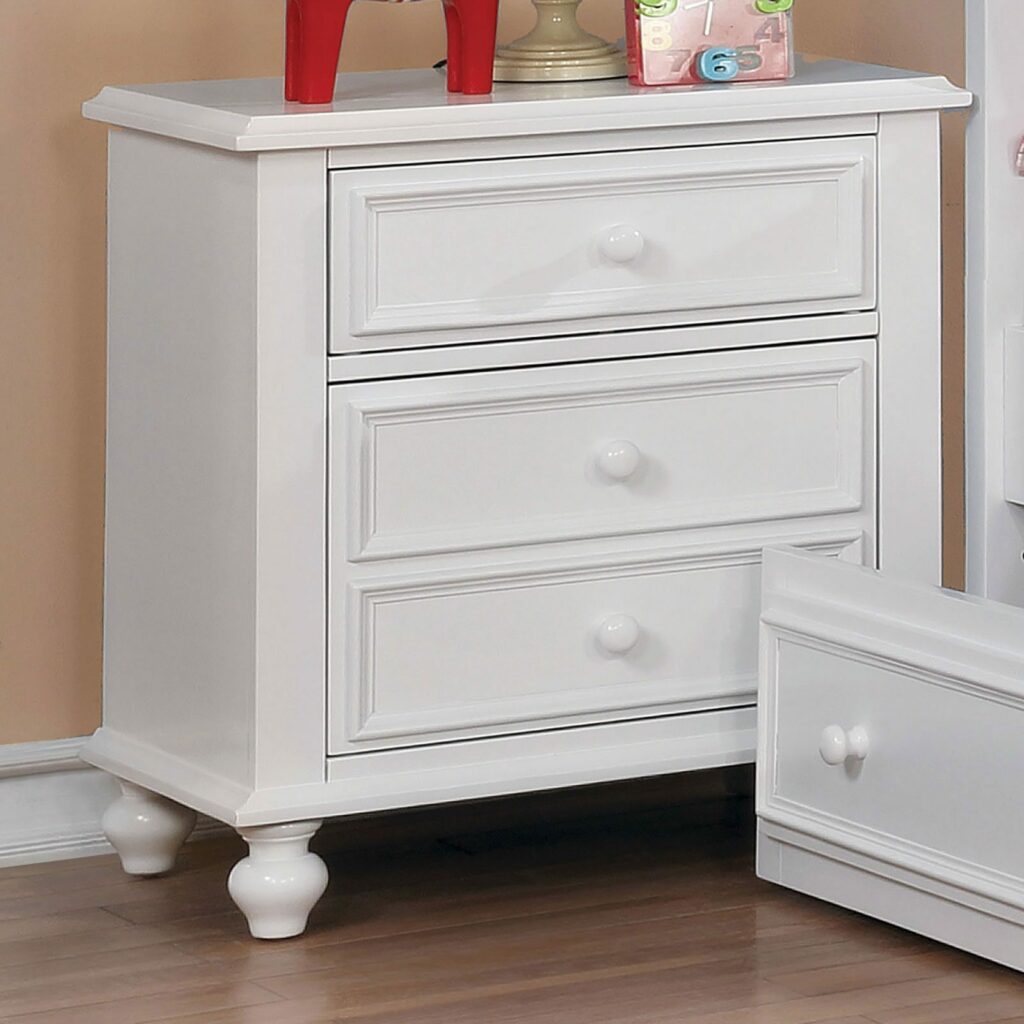
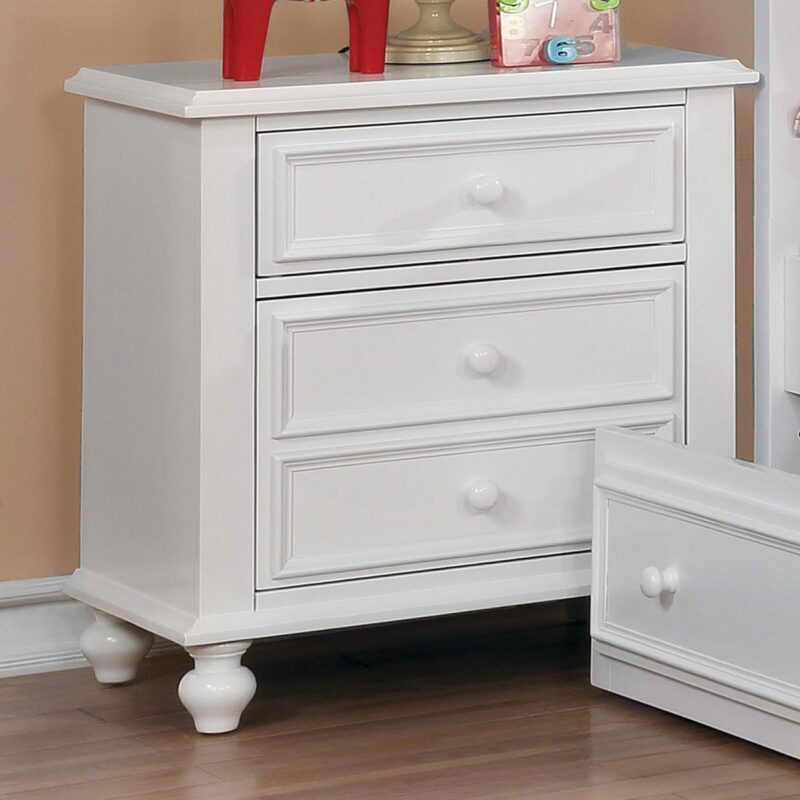
Olivia nightstand by Furniture of America
How High Should a Nightstand Be Compared to the Mattress?
Design guides agree on the principle even when they differ by an inch or two on the details. The nightstand top should land close to the mattress top. Several guides describe the sweet spot as level with the mattress or up to roughly 2 inches higher, and others accept about 1 to 2 inches either side. Almost all of them prefer slightly high over noticeably low, because reaching up a little is easier than reaching down, and a table that sits even a few inches under the mattress can feel awkward.
Here is a simple way to apply the rule at home:
- Make the bed the way you normally sleep on it, with the mattress pad, topper and any bedding you always use.
- Measure from the floor to the top of the mattress where the nightstand will stand. Do not measure the bed frame, because it is the mattress surface you reach from.
- Add zero to two inches to that number. That is your target nightstand height.
- If a piece you love is a little outside the target, choose the taller option rather than the shorter one.
The chart below applies that rule to three bed setups. The mattress-top figures are examples used by design guides to illustrate the rule, not measurements of any Mobilia Cleopatra bed, so replace them with your own measurement.
| Bed setup | Example mattress top (floor to surface) | Suggested nightstand height |
|---|---|---|
| Low platform bed | About 20 in | About 20 to 22 in |
| Standard frame and mattress | About 25 in | About 25 to 27 in |
| Tall bed or deep pillow-top mattress | About 30 in | About 30 to 32 in |
Notice that the standard row lands squarely inside the 24 to 28 inch range sold by most manufacturers. That is why that range is so common: it was built around the typical bed. If your mattress top is much lower or higher than the standard example, the chart shifts with it, and you may need to look beyond the usual selection.
Nightstand Height for Platform Beds, Standard Beds and Tall Beds
Low platform and low-profile beds
Platform beds sit closer to the floor, often with no box spring at all, so their mattress tops can be well under the typical 25 inches. Guides suggest pairing them with nightstands of roughly 20 to 24 inches, and some recommend staying under 24 inches. A standard 26 or 28 inch piece beside a very low platform bed looks oversized and makes the lamp sit near eye level while you lie down. Low-profile nightstands, wall-mounted shelves and floating designs all work here, and they follow the same mattress-height rule as any other table.
Standard frames
For a conventional frame with a box spring or foundation and a medium-thickness mattress, the typical 24 to 28 inch nightstand fits without any math. This is the case the majority of catalog pieces are built for, which is why bedroom sets pair nightstands, dressers and beds at proportionate heights. If you are buying matching pieces, our bedroom sets keep everything in scale, though you should still read the dimensions on each product page to confirm how the nightstand relates to your mattress.
Tall beds, pillow-tops and toppers
Tall upholstered or carved frames, thick pillow-top mattresses and added toppers all raise the sleeping surface. Guides put nightstands for taller setups at roughly 28 to 32 inches. This is where many shoppers go wrong, because a nightstand that matched the old mattress no longer lines up after a mattress upgrade. Re-measure whenever the mattress changes.
Headboard proportion
Height is not only about reach. A nightstand also reads against the headboard. If your headboard is very tall and ornate, a taller nightstand with drawers and a lamp usually looks better than a small table that disappears beside it, as long as the top stays within comfortable reach of the mattress.
Nightstand Width, Depth and Spacing
Height is only one of three numbers. Width and depth decide whether the piece fits the wall beside your bed and leaves room to move.
Typical widths vary more than heights. Design guides report standard nightstands running from about 21 to 29 inches wide, with a 24 to 28 inch width common, and they suggest going wider for a king bed. Depth is more compact, usually in the range of roughly 12 to 20 inches. Shallower nightstands suit narrow rooms and leave more space to walk; deeper ones hold bigger drawers but intrude into the aisle.
| Nightstand dimension | Typical range | What it affects |
|---|---|---|
| Height | 24 to 28 in | Reach from the mattress surface |
| Width | About 21 to 29 in | Balance with the bed and wall space |
| Depth | About 12 to 20 in | Walkway and drawer size |
Leave a clear path as well. Guides suggest keeping roughly 24 to 30 inches of walking space between furniture and the bed in a bedroom, and drawers need their own room to open. Before you commit to a wide, deep nightstand, tape its footprint on the floor and check that you can still step around it.
If you want a particular finish rather than a particular size, we group bedside pieces by look. Browse our white nightstands for a light, airy bedroom, or our gold nightstands when you want a metallic accent beside a darker bed. For the full selection, see our nightstand collection, and check each product page for exact dimensions.

Omnus dresser by Furniture of America
Standard Dresser Size: Height, Width and Depth
Dressers are less standardized than nightstands, and guides are upfront that there is no single fixed size. They do agree on a typical envelope. A standard horizontal dresser is about 30 to 36 inches tall, which is roughly waist height. Widths run from about 30 inches for a small piece to 70 inches or more for a wide one, and depth almost always lands between 18 and 22 inches, with 16 to 24 inches as the outer range.
The easiest way to compare is by type. The chart below sums up the ranges used in the sources behind this guide. They overlap, so read each row as a typical band, not an exact specification.
| Dresser type | Typical height | Typical width | Typical depth |
|---|---|---|---|
| Single (small, three to five drawers) | About 28 to 32 in | About 30 to 48 in | About 16 to 18 in |
| Double (six to nine drawers) | About 30 to 36 in | About 60 in | About 18 to 22 in |
| Triple or wide dresser | About 30 to 36 in | About 66 to 72 in | About 18 to 22 in |
| Tall chest (tallboy) | About 40 to 60 in | About 24 to 40 in | About 16 to 22 in |
A few notes help in reading the chart. A single dresser is the compact choice for a small room, a nursery or a guest room. A double dresser is the workhorse of most master bedrooms: wide enough to hold a couple of wardrobes of folded clothes and about 60 inches across, which is the figure that appears most often in the guides. A triple dresser is a name shoppers use for a very wide, three-column dresser; guides do not agree on a formal triple size, so we describe it by width, at the top end of the standard range. A tall chest trades width for height, giving you drawer volume in a narrow footprint.
Remember these are typical ranges. The exact figures vary by maker, drawer count and style, so confirm the dimensions listed on each product page. When you are ready to browse, our white dressers and black dressers are grouped by finish so you can compare sizes within a look.
Dresser Height: Low, Standard and Tall
Dresser height changes how a piece behaves in a room more than any other dimension, and it is worth thinking about before width.
The standard 30 to 36 inch dresser is the sensible default. At that height the top works as a surface for a mirror, a lamp, a tray or a small television, and you can reach the top drawer without a stretch. Many dresser mirrors are designed to rise from a dresser in this range, so if you plan to add a mirror, look through our dresser mirror selection and compare the proportions with your dresser top.
Lower pieces appeal when the dresser sits under a window or doubles as a media console. They disappear visually, which helps in a small or low-ceilinged room, but the top drawer is a little less comfortable and you give up some storage height.
Tall chests, around 40 to 60 inches, work the opposite way. They hold a lot in a narrow footprint, which is why they suit small bedrooms, walls between windows and corners where a wide dresser will not fit. The trade-off is that the top drawers sit high, so the chest suits items you reach less often. If a tall chest is on your list, browse our bedroom chests.
A good test is to match dresser height to what you want on top. If you want a mirror or a television, choose the standard height. If you want a quiet low line beneath a window, go lower. If you want maximum storage in the least floor space, choose a tall chest.
Clearance and Placement: Fitting the Dresser and Nightstands Together
A dresser that fits the wall may still fail the room, because drawers need space to open and you need space to stand while using them. The most repeated guideline is at least 36 inches of clear space in front of a dresser, so the drawers open fully and you can walk past an open one. Some guides recommend even more room for comfortable use, so more is better where the room allows.
Measure the route the piece must travel to get into the room, since doorways, hallways and stairwells often limit a wide dresser before the room does. If a double dresser will not pass through a tight turn, a tall chest or two smaller pieces may be the better answer.
When you place a dresser and nightstands in the same room, decide on a visual rhythm. Matching finishes and similar heights read as calm and formal, which suits traditional and French-inspired rooms. Contrasting pieces, such as a white dresser with darker nightstands, add interest, but keep the heights within a few inches so the room does not look uneven. A nightstand does not need to match the dresser height, but the two should feel related.
For a complete layout plan, including how to balance the bed, storage and seating, read the ultimate guide to bedroom furniture. If your room, ceiling or bed is unusual and nothing off the shelf lines up, the custom furniture program exists for exactly that situation, including when the reason to go custom is size.
Frequently Asked Questions
How tall should a nightstand be?
Most nightstands are 24 to 28 inches tall, and the best height is level with your mattress top or up to about 2 inches higher. Measure from the floor to the top of your mattress, including any topper, and use that number as your target.
How high should a nightstand be compared to the mattress?
Aim for the nightstand top to be even with the mattress or slightly above it. Staying within about 2 inches is comfortable, and if you must be off, slightly higher is easier than lower because reaching up is more natural than reaching down.
Should a nightstand be taller or shorter than the bed?
Level is the goal, and a little taller is the safer miss. A nightstand that is noticeably shorter than the mattress forces you to bend toward it, while one that is a couple of inches higher still feels natural.
What is the standard dresser size?
There is no single standard, but a typical dresser is 30 to 36 inches tall, 50 to 70 inches wide and 18 to 22 inches deep. A double dresser is usually about 60 inches wide, and small single dressers can be as narrow as 30 inches.
How tall is a standard dresser?
Most standard horizontal dressers are 30 to 36 inches tall, roughly waist height, which leaves a convenient top surface for a mirror or lamp. Lower models suit spots under windows.
How tall is a tall chest of drawers?
A tall chest, sometimes called a tallboy, is typically about 40 to 60 inches high, 24 to 40 inches wide and 16 to 22 inches deep. It stores a lot in a narrow footprint, so it works well in smaller bedrooms.
How much space do I need in front of a dresser?
Plan for at least 36 inches of clear floor in front of the dresser so the drawers can open fully and you can stand beside them. More room is more comfortable where the layout allows.
Does the nightstand need to match the dresser height?
No. The nightstand is sized to the bed, and the dresser is sized to the wall and your storage needs. They should look related in finish or style, but they do not need to share an exact height.
Choosing the Right Heights for Your Bedroom
The two rules that matter most fit in one sentence each. Choose a nightstand whose top is level with your mattress or slightly above it, usually 24 to 28 inches for a standard bed. Choose a dresser by what you want on top and how much floor you can spare, usually 30 to 36 inches tall with at least 36 inches of clearance in front.
Start with a tape measure rather than a catalog. Measure the mattress top, the wall space beside the bed, the wall for the dresser and the path into the room, then use the charts in this guide to narrow your options. When you are ready to compare finishes, browse our nightstands and the dresser collections linked above, and check each product page for exact dimensions. If you would like to see pieces in person, you are welcome at our Upland showroom at 280 N Benson Ave, Suite 6, Upland, CA 91786.
