Free shipping · 0% for 6 months · White-glove available


Dining Room Table Sizes: How to Choose by Seating and Room

Reviewed by the Mobilia Cleopatra design team
Quick answer: A rectangular dining table for four is typically about 48 by 36 inches, and one for six is typically 60 to 72 inches long by 36 to 40 inches wide. Round tables usually seat four at 42 to 48 inches across and six at 54 to 60 inches. Plan on about 24 inches of table edge per person, and leave roughly 36 inches between the table edge and the nearest wall or furniture so chairs can slide out.
Shopping for a dining table is a little like tailoring a jacket: the style matters, but the fit decides whether you enjoy it every day. A table that is too small turns holiday dinners into a game of elbows. A table that is too large leaves no room to pull out a chair, let alone walk behind it. The good news is that dining room table sizes follow a handful of predictable patterns, and once you know them you can match a table to your household, your guest list and your room in a few minutes with a tape measure.
This guide gives you a seating chart for every common shape, explains how much room each person really needs, and shows how to check your floor plan before you buy. The figures here are typical industry guidelines that several furniture and home-advice publishers repeat, not strict rules. Exact dimensions vary from one design to the next, so always check each product page for the measurements of the piece you are considering.
Dining Room Table Sizes at a Glance
If you only need the headline numbers, this chart shows typical table sizes by number of seats. Think of the first column as a comfortable, everyday fit for adults, and expect to squeeze in one or two more people on special occasions, with a little less elbow room each.
| Seats | Rectangular (length x width) | Round (diameter) | Square | Oval (length x width) |
|---|---|---|---|---|
| 4 | About 48 x 36 in. | 42 to 48 in. | About 36 x 36 in. | Smaller ovals are less common |
| 6 | 60 to 72 x 36 to 40 in. | 54 to 60 in. | About 48 x 48 in. | About 72 x 36 to 42 in. |
| 8 | About 78 to 96 x 36 to 42 in. | About 72 in. | Rare; usually too wide to reach across | About 84 x 40 to 42 in. |
| 10 | About 96 to 108 x 42 in. | Not common; very large | Not recommended | About 96 x 42 in. |
Two things to keep in mind as you read the chart. First, seat counts depend on the chairs: slim side chairs let you seat more people, while chairs with arms need more room each. Second, length is only half the story. Width decides whether guests can sit across from one another comfortably and whether you have space for serving dishes down the middle.
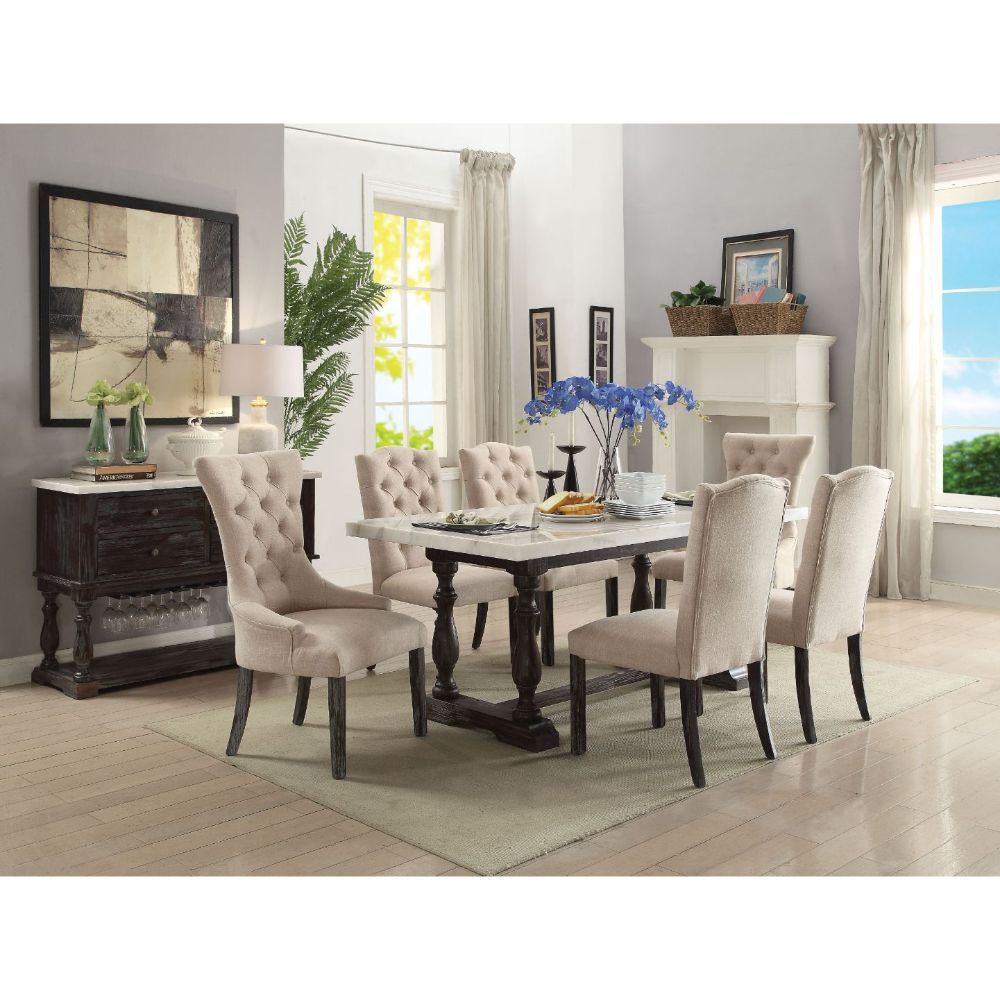
Gerardo white marble top dining table by ACME
Standard Dining Table Size for Rectangular Tables
The rectangle is the classic shape and the most space-efficient at seating people. When designers talk about a standard dining table size, they usually mean a rectangular top that is about 36 to 42 inches wide. That width gives each person room for a place setting and leaves a strip down the center for platters, candles or a runner. Narrower tops of 30 to 36 inches suit tight rooms but feel crowded once you add serving dishes, while tops of 42 to 48 inches feel generous and are worth considering if you entertain often.
Length is what changes with the number of seats. As a rough guide, a table around 48 inches long seats four, 60 to 72 inches seats six, about 78 to 96 inches seats eight, and 96 to 108 inches or more seats ten. Longer tables also usually give you the option of a host chair at each end, which is lovely for a formal meal but adds roughly a chair’s depth to the total footprint of the table and its seating.
If your room is long and narrow, a rectangular table is usually the natural fit, because it follows the shape of the space. In a smaller room, you can often choose a shorter rectangular table and keep the walking paths clear. When you are comparing designs, browse our dining tables to see how different top shapes, leg styles and finishes change the look of the same basic footprint.
Dining Table Size for 6 People
Six is the most common household and guest count, so it is the size most shoppers search for. A rectangular table for six is typically 60 to 72 inches long and 36 to 40 inches wide. At the shorter end, 60 inches, three people sit comfortably along each side with no one at the ends. At 72 inches you gain breathing room, and you can add a chair at each end for a seventh and eighth guest only if everyone sits close; for eight people comfortably, most sizing guides point to about 78 inches or more.
A round table for six is typically 54 to 60 inches across, and a square table for six is typically around 48 inches on each side, although a square that size is close to its limit for reaching the middle of the table. An oval table for six is typically about 72 inches long and 36 to 42 inches wide.
Which one is right for you? If you often host a seventh or eighth guest, choose the larger end of the range or an extendable top. If your room is modest, a 54 to 60 inch round table seats six in less visual space than a long rectangle. If you would rather buy furniture as a matched group, browse our dining room sets for 6 and check each product page for exact dimensions before you commit.
Round Dining Table Size
Round tables are the friendliest shape for conversation, because everyone faces everyone else and nobody sits at a distant end. They also fit well in square rooms and in open spaces where a corner would otherwise stick out into a walkway. The trade-off is that seating does not grow as quickly with size: once a round table passes about 60 inches across, the center becomes a long reach for passing dishes.
Typical round dining table sizes by seating:
- Seats 4: 42 to 48 inches in diameter. A 36-inch round can technically seat four but is a squeeze once the plates and glasses arrive.
- Seats 6: 54 to 60 inches in diameter.
- Seats 8: about 72 inches in diameter, which needs a large room.
Pedestal bases are popular on round tables because there are no legs at the corners to bump into, so chairs can be tucked in at any angle. If you like that look, browse our collection of round dining tables to compare traditional and more modern profiles. A round table also pairs well with a rug that extends past the chairs, which keeps chair legs from catching on the edge as guests sit down and stand up.
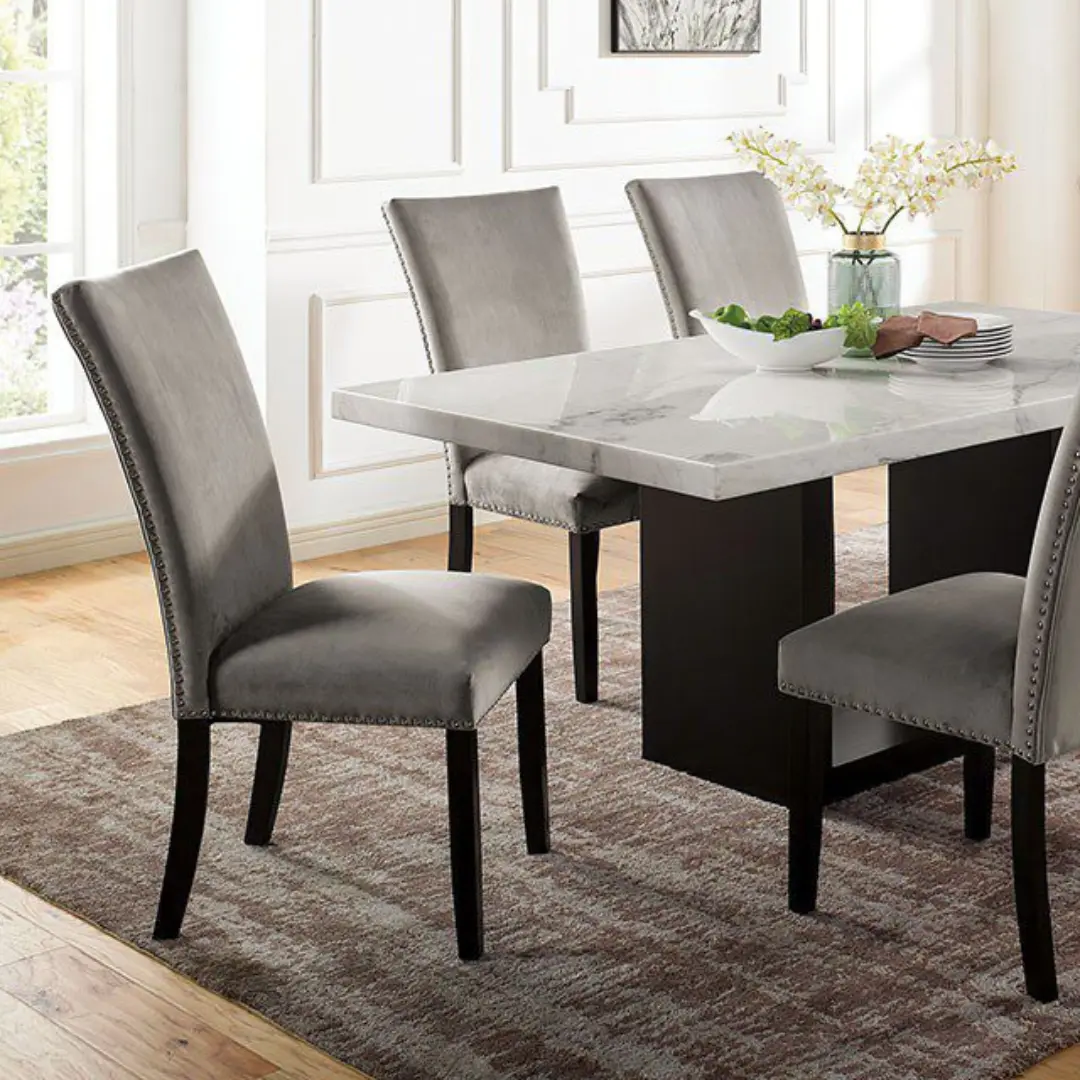
Kian dining table by Furniture of America
Square and Oval Dining Tables
Square tables
Square tables sit between the round and the rectangle. A 36 by 36 inch top seats four, one person per side, and a 48 inch square seats up to six. They suit square rooms, breakfast nooks and intimate settings. Beyond about 48 inches, though, the center is hard to reach, so a square is rarely the best choice for larger gatherings. If you plan to seat more than six regularly, a rectangle, oval or large round will serve you better.
Oval tables
An oval has the seating capacity of a rectangle of similar length, with softened ends that make it easier to walk around in a tight room. Typical sizes are about 72 inches by 36 to 42 inches for six and about 84 inches by 40 to 42 inches for eight. Because the corners are rounded, you may not be able to fit a chair at the very tip as neatly as at a rectangular end, so treat the largest seat counts as a guide rather than a promise.
In a formal dining room with a buffet or a china cabinet, an oval can give you a more graceful path around the table. It is also a good option for households with young children, who tend to find sharp corners at exactly the wrong height.
How Much Room Does Each Person Need?
Most sizing charts are built on one simple number: about 24 inches of table edge per person. That is enough for a place setting and a little elbow room, and it is the figure behind most of the seat counts above. You can adjust it to suit the way you dine:
- Tight, for a casual crowd: a little under 24 inches per person. Fine for an occasional overflow guest, but you will bump arms.
- Standard: about 24 inches per person. This is the practical minimum for everyday comfort.
- Roomy: 26 to 30 inches per person. Better for formal dinners, long meals and chairs with arms.
To check a table you like, divide the usable edge length by 24. A 72-inch rectangular table has 144 inches of edge along its two long sides, which is about six people along the sides, plus one at each end if the width allows. A 60-inch round table has an edge of roughly 188 inches, but chair width and the curve limit it to about six comfortably.
Chair style matters here. Slim side chairs allow tighter spacing; wide upholstered or arm chairs need more. If you want to save space along one side, you can swap the chairs for a bench. Browse our dining benches to see options that tuck neatly under a table and let you slide in an extra guest at family meals.
Room Clearance: The 36-Inch Rule
A table is only as useful as the room around it. The most common guideline you will see is to leave about 36 inches between the table edge and the nearest wall or piece of furniture. That gives a seated guest space to push back, stand up and pass behind a neighboring chair. If the space behind the chairs is also a walkway, such as the route from the kitchen to a living room, plan for more, usually 42 to 48 inches. If a buffet or sideboard sits on one wall, allow extra so that drawers and doors can open without hitting a chair.
Here is a simple way to estimate the room you need: add the table length to twice the clearance. A 72-inch table with 36 inches on each end needs a room at least 144 inches long, or 12 feet. Do the same for width. A 40-inch-wide table with 36 inches on both sides needs a room at least 112 inches, or about 9 feet 4 inches, wide. If your room is smaller, consider a shorter table, a round table or a design with a pedestal base, or put a bench along one side so you do not need as much space to pull chairs out.
The easiest test costs nothing. Mark the table outline on the floor with painter’s tape, set a few chairs around it, and walk the room. If you can pull each chair out and move behind it without turning sideways, the size works. If you would like help matching a table and chairs, our guide to choosing a dining room set walks through that decision in more detail.
Table Height, Shape and Style: Putting It All Together
Size is more than length and width. Height affects whether the chairs, the table and your elbows all line up. We cover typical heights, chair pairings and what changes for round and extendable tables in our separate guide on how tall dining tables are, so we will not repeat the details here. The short version is that standard dining tables sit lower than counter-height designs, which need matching stools. If you prefer a casual kitchen look, browse counter-height dining tables and plan a little extra clearance for the stools.
Once the footprint is settled, finish and material are the fun part. Visual weight also affects how large a table feels in a room. A heavy, dark top with a thick base looks bigger than a light one of the same size. A pale surface feels airy, and you can see that in a white dining table, which tends to recede in a small room. A stone top has presence, as in a marble dining table, and often calls for a slightly more generous room around it so the piece can be admired.
If you would like a table and chairs sold as a matching group, our dining sets bring top and chairs together, and you can check each product page for exact dimensions of the table, chairs and any leaf. Our Upland showroom at 280 N Benson Ave, Suite 6, Upland, CA 91786 is also a good place to see how large a table feels in person.
Frequently Asked Questions
What is the standard dining table size?
There is no single standard, but a rectangular top that is 36 to 42 inches wide and about 60 to 72 inches long is the most typical size, and it seats six. Smaller households often choose 48 by 36 inches for four, while larger ones go to 84 inches or more.
What size dining table do I need for 6 people?
Choose a rectangular table about 60 to 72 inches long and 36 to 40 inches wide, or a round table 54 to 60 inches across. Allow roughly 24 inches of table edge per person and about 36 inches of clearance around the table.
What size is a round dining table for 4, 6 and 8?
Typical diameters are 42 to 48 inches for four, 54 to 60 inches for six and about 72 inches for eight. Larger round tables need more room and make the center harder to reach.
How many people fit at a dining table?
Divide the usable table edge by 24 inches for a comfortable estimate. A 72-inch rectangular table seats about six comfortably. For eight people, plan on a table about 78 to 96 inches long. Chair width, arms and table bases change the count.
How much space should be between the dining table and the wall?
About 36 inches is the usual guideline, enough to pull out a chair and sit down. Allow 42 to 48 inches if people will walk behind the chairs, and extra space if a buffet or cabinet has doors or drawers that open.
Is a 60-inch round table big enough for 6?
Yes, a 54 to 60 inch round table typically seats six adults comfortably. Eight is possible only with a tight fit, and most guides point to 72 inches for eight.
Which dining table shape is best for a small room?
A round or square table usually fits small and square rooms best, because there are no long ends to work around. A shorter rectangle or an oval with a pedestal base can also work well. Compare shapes side by side in our dining room collections.
Should I buy a bigger table than I need?
Only if the room allows it. A table that leaves less than about 36 inches of clearance feels cramped every day, while a slightly smaller table with room to move feels more comfortable even with a full house.
Final Thoughts on Choosing Your Dining Table Size
The right dining table size comes down to three numbers: how many people you seat, about 24 inches of edge for each of them, and about 36 inches of free floor around the table. Start with your usual headcount, add a seat or two for guests, choose the shape that suits your room, and test the footprint with tape on the floor. Rectangles give you the most seats per foot of length, rounds make a room feel friendly, squares suit small spaces and ovals soften a tight walkway.
From there, pick the finish, chairs and details you love, and check every product page for its exact dimensions before you order.
