Free shipping · 0% for 6 months · White-glove available


Bed Size Chart: Mattress Dimensions and Room Size Guide

Reviewed by the Mobilia Cleopatra design team
Quick answer: The six standard U.S. bed sizes are twin (38 x 75 in), twin XL (38 x 80 in), full (54 x 75 in), queen (60 x 80 in), king (76 x 80 in) and California king (72 x 84 in). As a rule of thumb, a queen is comfortable in a room of about 10 x 10 ft, while a king or California king is usually given about 12 x 12 ft. These are mattress sizes, so a frame and headboard will make the finished bed larger.
Choosing a bed is one of the few furniture decisions you live with every single night, and it is also one of the easiest to get wrong. The names are confusing (is a full the same as a double? is a California king bigger than a king?), the numbers are rarely printed where you can find them, and the bedroom you are shopping for has walls, doors and nightstands that all take up space. This bed size chart puts the standard dimensions in one place, in inches and centimeters, then walks through how to match a size to the sleepers, the room and the style of bed you have in mind.
Everything below describes typical, standard measurements published by mattress makers and retailers. Mattress sizes are nominal, so a given maker may differ by an inch or so, and furniture frames vary even more. Always check the dimensions listed on each product page before you buy, and measure your own room and doorways before you commit.
The Standard Bed Size Chart
In the United States, mattresses come in six sizes that nearly every retailer and manufacturer recognizes. Dimensions are given as width by length, and the centimeter figures are rounded to the nearest whole number.
| Size | Width x length (inches) | Width x length (cm) | Typically suits |
|---|---|---|---|
| Twin | 38 x 75 | 97 x 191 | One child or smaller adult |
| Twin XL | 38 x 80 | 97 x 203 | One taller sleeper, dorms, guest rooms |
| Full (double) | 54 x 75 | 137 x 191 | One adult wanting extra width |
| Queen | 60 x 80 | 152 x 203 | One or two adults |
| King | 76 x 80 | 193 x 203 | Two adults who want width |
| California king | 72 x 84 | 183 x 213 | Two adults, especially taller ones |
A few notes on reading the chart. Some makers list a full mattress at 53 inches wide rather than 54, which is a good reminder that these are nominal figures. The twin and twin XL are the same width and differ only in length, and the king and California king trade width for length. If you remember only one pattern, remember that: the standard sizes get wider as you move up the chart, except for the California king, which is narrower than a king but five inches longer.
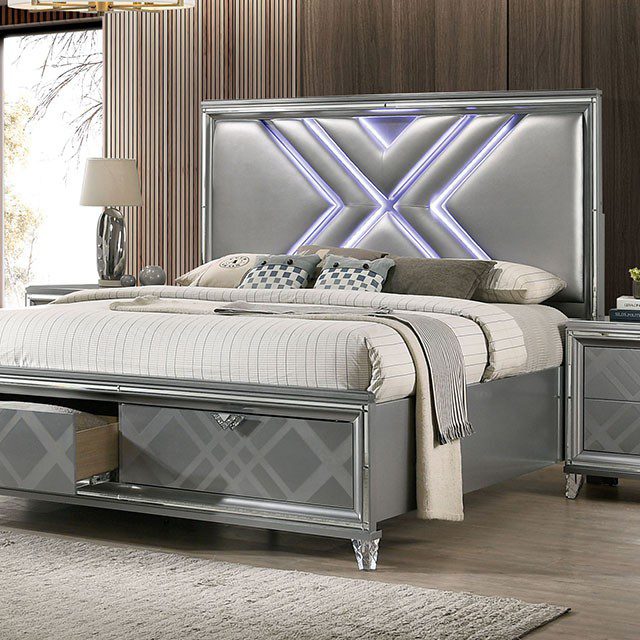
Emmeline bed by Furniture of America. Check each product page for the exact bed size and dimensions.
Twin, Twin XL and Full Beds
Twin
A twin measures 38 x 75 inches and is the smallest of the standard adult-compatible sizes. It is the classic choice for a child’s room, a bunk or trundle arrangement, and a narrow guest room. Because the width is shared with the twin XL, the two take up the same floor width, and the only question is whether you need the extra five inches of length.
Twin XL
The twin XL, at 38 x 80 inches, is the practical upgrade for anyone approaching six feet tall or more, and it is the size commonly used for dorm beds. It also matters for a different reason: two twin XL mattresses placed side by side measure 76 x 80 inches, the same footprint as a king. That is how a split king is built, and it is why adjustable bases are often sold in twin XL pairs.
If you are furnishing a young person’s space, browse our youth beds to see the frames and styles we offer, and check each product page for the mattress size a bed is designed to take.
Full
A full, also called a double, is 54 x 75 inches. It is only about 16 inches wider than a twin, and it has the same length as a twin, which makes it a tight fit for two adults. Divide the width between two sleepers and each person gets about 27 inches, which is noticeably less than most people expect.
That does not make the full a poor choice. It suits a single adult who likes room to stretch out, a teenager who will not outgrow the bed quickly, or a small guest room where a queen would crowd the walkway. The full also tends to be the first size where people start to feel the pinch of length, so taller sleepers often skip straight to a queen.
Queen: The Most Popular All-Rounder
At 60 x 80 inches, the queen is the size most households settle on. It gives two adults roughly 30 inches each, matches the length of a king, and fits in a modest primary bedroom as well as a guest room. Because queen bedding, frames and accessories are produced in such volume, it is also the easiest size to dress and to replace later.
Queen is the size to choose when the room is somewhere between small and generous, and when you are not certain who will use the bed in five years. If you are shopping for a coordinated look, our queen bedroom sets bring a bed, nightstands and often a dresser together, so you can compare finishes and proportions in one place.
King and California King: Which One Fits You?
The king is the widest standard mattress, at 76 x 80 inches. Two sleepers get about 38 inches each, which is the width of a twin, so couples who share a bed with children or pets, or who simply move a lot at night, usually appreciate it. The California king is 72 x 84 inches, four inches narrower but four inches longer, so it often suits taller sleepers and narrower rooms.
The decision usually comes down to height and room shape. A person over about six feet tall will notice the extra length of a California king, while a wide, square room often accommodates a standard king more gracefully. We cover the trade-offs in detail in our guide to California king versus king beds, including how each behaves with bedding and bed frames.
Whichever you choose, remember that a king-size bed becomes a major piece of furniture. If your room can take it, see our California king bedroom furniture sets for matched pieces built around that mattress size, and check the listed dimensions of the bed and the nightstands on the product pages.

Mat Monica bed with storage by ESF Furniture
Beyond the Standard Six: Specialty Sizes
You will occasionally see other names, particularly in older homes, recreational vehicles or specialty catalogs. Olympic queen, short queen, RV king, Texas king and Wyoming king are all real sizes, and the largest, the Alaskan king, is commonly listed at 108 x 108 inches. These sizes are produced by far fewer manufacturers, so sheets, mattresses and frames can be harder to find and sometimes need special ordering.
If the standard six do not suit your room or your height, a custom piece is a more reliable route than hunting for an unusual size. Our design-your-own furniture option exists for exactly that kind of requirement, where the dimensions of the piece are the reason you are going custom. For anything off the standard chart, confirm the exact mattress dimensions with the maker before you order.
Standard Bed Frame Dimensions and Why They Differ from the Mattress
The chart above describes the mattress, not the bed. A frame has side rails or a surround, a headboard that may be shallow or deep, and sometimes a footboard. Together these add width and length beyond the mattress, so a queen bed is rarely a clean 60 x 80 inches on the floor.
How much it adds depends entirely on the design. A slim platform bed adds very little, while a sleigh bed, a tufted headboard, a canopy or a storage bed with drawers can add a good deal more. Ornate traditional and Victorian-style designs, with their carved or upholstered headboards, tend toward the bigger end. This is why we always recommend working from the finished dimensions listed on the bed’s own page, not the mattress size, when you plan your layout.
- Headboard depth: a thick upholstered or carved headboard pushes the bed further into the room.
- Footboard: adds length and can restrict walkway space at the foot.
- Side rails and storage: drawers and wide rails add width on both sides.
- Mattress height: thicker mattresses sit higher and may not suit every frame, so check compatibility.
To compare frame styles and finishes, start with our full range of bedroom beds, and look at the product page for each bed’s own measurements.
How Much Room Does Each Bed Size Need?
There is no official minimum, and anyone who tells you otherwise is giving a rule of thumb. Still, the guidance published by mattress sellers is fairly consistent for the common sizes, and we have only listed figures that more than one source agrees on. Treat them as the smallest room in which the bed fits with some walking space, not as the ideal.
| Size | Typical minimum room (feet) |
|---|---|
| Twin | About 7 x 10 |
| Twin XL | About 7 x 10 |
| Queen | About 10 x 10 |
| King | About 12 x 12 |
| California king | About 12 x 12 |
We have left the full size out of the table on purpose. Published guidance for a full ranges from roughly 9 x 10 feet to 10 x 12 feet depending on the source, so the safest approach is to plan it somewhere between a twin and a queen and measure your own room. A few sellers also quote a smaller king minimum, but 12 x 12 feet is the figure most of them reach.
Clearance matters as much as the room total. Sources commonly suggest leaving roughly 24 to 30 inches of open floor along the sides and foot of the bed so you can walk around it, make it and open drawers. Remember too that these room sizes assume the bed alone, so if you want a dresser, a bench and two nightstands, you will want a more generous room.
Planning the rest of the bedroom around the bed
Once you know the bed size, work outward. Start by sketching the room on graph paper or marking the floor with painter’s tape at the bed’s finished footprint. Then add the furniture you want, and keep the walking paths clear.
Nightstands are usually the first companion piece to consider. A king bed in a room of about 12 x 12 feet can look undersized next to tiny nightstands and overwhelmed by large ones, so choose pieces in proportion to the headboard. Browse our bedroom nightstands and read each listing for its dimensions before settling on a pair.
If you would rather buy the bed and its companions together, our bedroom sets are a practical shortcut because the pieces are designed to share a style and finish. Always confirm the dimensions on the page for each piece, since set contents differ from one listing to the next. For a wider look at layout, storage and style, our guide to bedroom furniture covers the other pieces in more depth.
Do not forget the route into the room. Measure doorways, hallways, stairwells and tight turns, particularly for a king or California king, and for headboards that are assembled before delivery. A bed that fits the room perfectly is no help if it cannot get through the door.
How to Choose Your Bed Size
Run through these questions in order and the right size is usually obvious.
- How many people sleep in the bed? One sleeper can choose from any size, while two adults generally do best in a queen or larger.
- How tall is the tallest sleeper? Someone around six feet or taller will probably want the length of a twin XL, king or California king.
- How big is the room? Use the room-size table above, add your other furniture, and keep 24 to 30 inches of open floor around the bed.
- Will your needs change? If a child, a partner or a pet may join the bed, buying one size up can save you from replacing it.
- Can it get inside? Check doorways and stairs before you order.
Also think about the mattress itself. If you are buying a new one alongside the bed, our mattress and foundation category is a good place to look, and the product pages list the sizes offered. Match the mattress size to the frame exactly, because a mattress that is too small leaves gaps and one that is too large will not sit properly.
If you would like to see how different bed sizes look in person, you are welcome to visit our Upland showroom at 280 N Benson Ave, Suite 6, Upland, CA 91786, or call (909) 999-1442 with questions.
Frequently Asked Questions
What are the standard bed sizes?
The standard U.S. sizes are twin (38 x 75 in), twin XL (38 x 80 in), full (54 x 75 in), queen (60 x 80 in), king (76 x 80 in) and California king (72 x 84 in). Dimensions can vary by about an inch between makers.
Which is bigger, a king or a California king?
The king has more surface area and is wider, at 76 x 80 inches, while the California king is narrower and longer, at 72 x 84 inches. A taller sleeper often prefers the California king, and a wider room often suits the king.
Is a full bed big enough for two people?
Technically yes, but it is tight. At 54 inches wide, each person gets about 27 inches, so most couples prefer a queen. A full is better suited to one adult who wants extra room.
What is the difference between a twin and a twin XL?
They are the same width, 38 inches, but the twin XL is five inches longer at 80 inches versus 75. The extra length is helpful for teenagers and adults who are taller.
What size room do I need for a queen bed?
Many mattress sellers suggest about 10 x 10 feet as a minimum for a queen, and more if you want a dresser and nightstands. Check the finished size of your frame, since headboards and footboards add to the footprint.
What size room do I need for a king bed?
The most common recommendation is about 12 x 12 feet as a starting point, with more space for additional furniture. A California king is generally given the same figure.
Are bed frames the same size as mattresses?
No. A frame is built to hold a mattress of a given size, but the rails, headboard and footboard make the finished bed larger than the mattress alone. Check the dimensions on each product page.
Are mattress sizes the same across brands?
The sizes are standardized in name but nominal in practice, so a mattress can differ by an inch or so from one maker to another. When you are buying a frame and mattress separately, confirm that they are listed for the same size.
Final Thoughts on Choosing a Bed Size
The best bed size is the largest one that still leaves comfortable room to move, because you will notice a cramped room every day but a generous mattress every night. Use the bed size chart to shortlist two sizes, check the finished dimensions of the frame you love, and measure your room and your doorways. If a standard size simply does not work, a custom option may be the answer.
When you are ready to see styles, begin with our beds and bedroom sets, and remember that exact dimensions are always on each product page.
