Free shipping · 0% for 6 months · White-glove available


Marble Luxury Furniture: A Complete Guide to Elegant Stone Furniture for Luxury Interiors

Reviewed by the Mobilia Cleopatra design team
Quick answer: Marble luxury furniture uses natural marble, usually as the top of a dining table, coffee or end table, console, nightstand, or dresser, set on a wood or metal base. Popular marbles include white Carrara, boldly veined Calacatta and Statuario, warm Emperador and Botticino, and black Nero Marquina. Real marble is unique and timeless, but it is heavy, relatively soft, and sensitive to acids, which can etch (dull) the polish. Faux marble, engineered stone, and sintered stone copy the look with less upkeep. If you choose genuine marble, use coasters and trivets, blot spills quickly, clean with a pH-neutral stone cleaner, and ask whether the top should be sealed.
Marble has dressed palaces and grand houses for centuries, and in furniture it does something few materials can: it makes one piece feel architectural. A marble dining table, coffee table, or slim console can set the tone for a whole room.
Buying marble furniture is both an aesthetic and a practical decision. Every slab has its own veining, tone, and movement, so no two tops are exactly alike. That individuality is the main reason people choose natural stone. The same stone, though, reacts to lemon juice, wine, and harsh cleaners in ways that wood and glass do not, and a large top can weigh well over 100 pounds.
This guide covers the pieces where marble works best, the main marble types, real versus faux and sintered stone, honest pros and cons, sealing and care, and how to choose and style the right piece.
What Is Marble Luxury Furniture?
Marble luxury furniture is furniture in which natural marble is a central design element, almost always as a tabletop or case top supported by a base of solid wood, metal, or a mix of both. Marble is a metamorphic stone made mainly of calcium carbonate. Over long geological periods, heat and pressure recrystallize limestone into marble, and minerals moving through the stone create the veins, clouds, and color shifts that make each slab distinct.
That chemistry matters to owners. The Natural Stone Institute classifies stones like marble as calcareous, meaning they are made mainly of calcium carbonate, which is sensitive to acidic solutions. Siliceous stones such as granite are composed mostly of silicate minerals and are generally more resistant to household acids. In practice, this is why a marble top can lose its shine where a glass of orange juice sat, while a granite top usually would not.
Luxury in marble furniture is not only about the stone. The top must be cut cleanly, finished well at the edges, and carried by a base that does not wobble and looks proportionate to the slab. When stonework, base, and finish work together, marble becomes the identity of the piece rather than a decorative add-on.

Designer marble luxury furniture collection
Types of Marble Furniture for Every Room
Marble shows up most often on flat, horizontal surfaces, where its veining is visible and its weight is supported from below. These are the main categories to know.
Marble dining tables
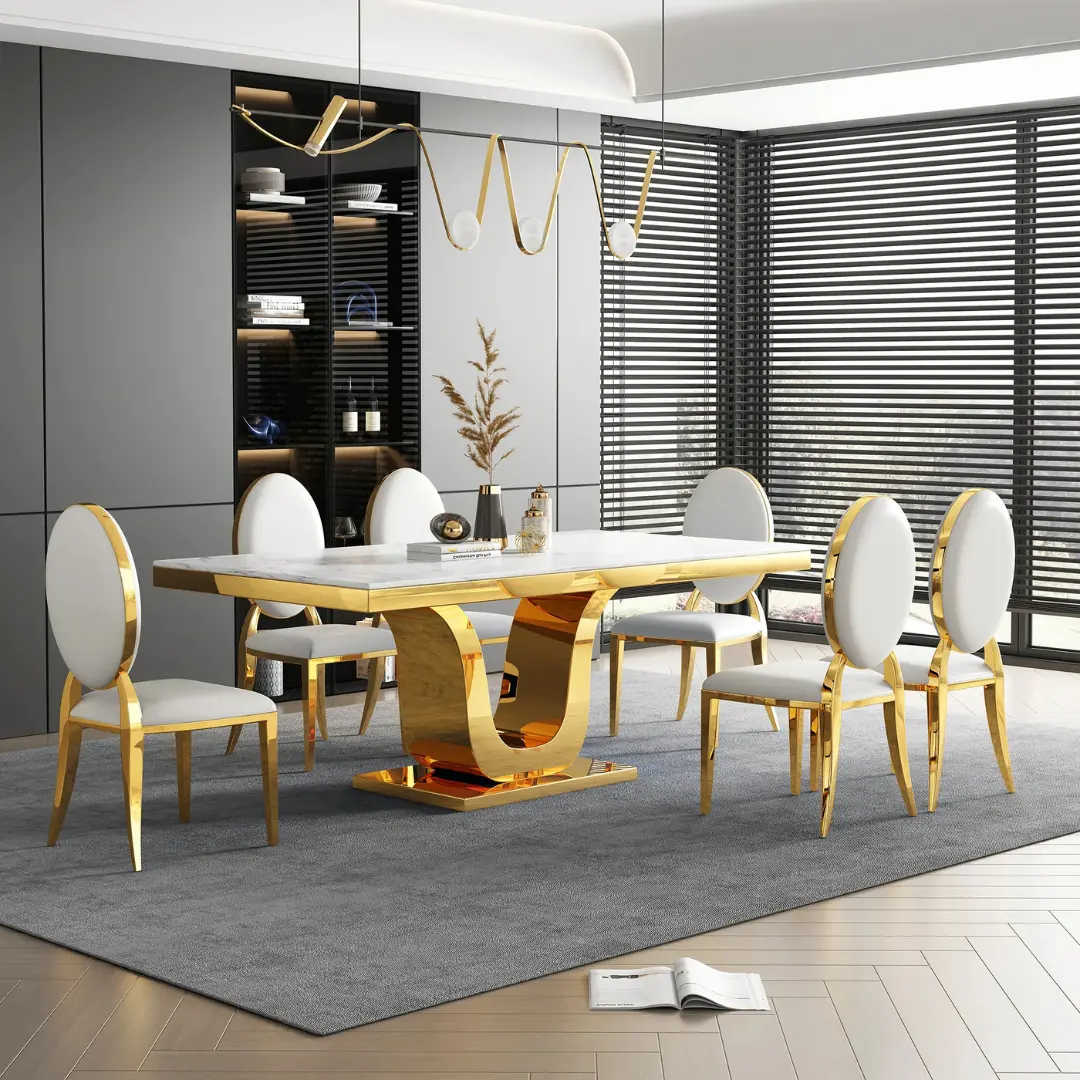
A marble dining table is the most dramatic use of the stone and the one that sees the most wear. Rectangular and oval tops suit formal rooms and larger gatherings. Round tables feel more conversational and work well in breakfast rooms and open-plan spaces. Our dining table collection includes marble-top designs in contemporary and traditional styles. In the Kleopatra Kingdom line, for example, the Handmade Royal Copper Round Marble Top Dining Table pairs a round marble top with a carved Rococo base of natural beech wood, listed at about $3,000 as of October 2026.
Marble coffee tables and end tables
A marble coffee table anchors a seating area and adds stone to a room without a full redesign. You can browse stone-topped options among our luxury coffee tables and our side and end tables. One example is ACME’s Jacory coffee table, whose product page lists a Bottocino marble top on solid mango wood legs at about $460 as of October 2026, with a listed weight of 129 lbs, a useful reminder of how heavy even a mid-size stone top can be.
Console tables and servers
Consoles sit at eye level as you walk past, which makes them ideal for showing off veining in an entryway, hallway, or behind a sofa. Marble-top servers and buffets add a durable serving surface to the dining room. Among our console tables, ACME’s Markku console is listed with a genuine marble top about 1.7 inches thick and an oak finish, at about $1,000 as of October 2026.
Nightstands and dresser tops
In the bedroom, marble usually tops a nightstand, chest, or dresser. Wear is light here, so even a polished finish stays beautiful with little effort. In our nightstand collection, McFerran’s B6005-N is listed with a genuine marble top over a solid wood frame in an antique walnut finish, at about $520 as of October 2026.
Popular Marble Types Used in Furniture
Marble names usually describe a look and a source region rather than a strict standard, and two slabs sold under the same name can differ noticeably. Still, the common names give you a useful vocabulary when you shop.
Carrara
Carrara, from the area around Carrara in Tuscany, Italy, has a white to soft gray background with fine, feathery gray veining. Its quiet pattern pairs with almost any wood or metal, which is why it is so common on coffee tables, side tables, and dining tops.
Calacatta and Statuario
Calacatta and Statuario come from the same Italian region but are prized for whiter backgrounds and bolder, more dramatic veins. Calacatta often shows thick gray veining with gold or warm tones, while Statuario has strong gray veins on a bright white ground. Both are favorites for statement pieces and typically cost more than Carrara.
Nero Marquina
Nero Marquina is a deep black marble from Spain with crisp white veins. It suits Art Deco, modern classic, and high-contrast interiors, and it looks especially striking on consoles and side tables paired with brass or gold.
Emperador, Botticino, and warm-toned stones
Emperador marbles come in brown tones with lighter veins and bring warmth to traditional rooms. Botticino, from northern Italy, is a cream to beige stone with soft veining that pairs well with dark wood. Travertine and onyx are sometimes sold alongside marble: travertine has an earthy, pitted texture that is usually filled, and onyx can be translucent and is best kept for decorative pieces that see little wear. Because every slab varies, ask for a photo of the actual top when the pattern matters.
Real Marble vs. Faux Marble, Engineered Stone, and Sintered Stone
Many products described as “marble” are not solid natural stone, so the material line on the product specs matters more than the product name. These are the four surfaces you will meet most often.
| Surface | What it is | Strengths | Trade-offs |
|---|---|---|---|
| Natural marble | Quarried stone, cut into slabs | Unique veining, depth, can be honed and repolished | Etches with acids, can stain and scratch, heavy, higher cost |
| Faux marble | Printed laminate, film, or painted finish over a wood-based core | Light, affordable, easy to wipe | Pattern can look flat up close; deep chips or scratches expose the core and are hard to repair |
| Engineered stone / cultured marble | Crushed stone (quartz or marble) bound with resin | More uniform, usually less porous than natural marble | Repeating pattern, resin can be sensitive to high heat |
| Sintered stone / ceramic | Mineral particles fused under very high heat and pressure | Very low porosity, resists stains, heat, and scratches | Printed veining lacks natural depth; edges can chip |
Our catalog shows how varied listings can be. McFerran’s 78-inch Faux Marble Dining Table is listed with a faux marble top on an engineered wood base, at about $550 as of October 2026. ACME’s Destin dining table is described as a black marble look on a sintered stone and ceramic top with tempered glass support, about $750 as of October 2026. Coaster’s Astoria round end table, by contrast, is listed with a genuine white marble top, under $300 as of October 2026.
For a broader look at how stone compares with wood, metal, and upholstery in high-end pieces, see our guide to custom luxury furniture materials.
Pros and Cons of Marble Furniture
The advantages
- Unique beauty: every top is one of a kind, with natural depth that prints and patterns cannot fully reproduce.
- Timeless style: marble has stayed in fashion for centuries and suits classic and modern rooms alike.
- Stability: the weight that makes marble hard to move also keeps tables steady and feeling substantial.
- Repairable: a solid slab can often be honed and repolished by a stone professional, which a printed surface cannot.
The drawbacks
- Etching: acids in citrus, wine, vinegar, tomato sauce, and some cleaners react with calcium carbonate and leave dull marks. Etching is a change to the surface itself, so it does not wipe away like a stain, and sealing does not prevent it.
- Staining: marble is porous to varying degrees, so oil, coffee, and wine can soak in if left sitting.
- Scratches and chips: marble is softer than granite or sintered stone, and sharp edges or dragged objects can mark it.
- Weight: large tops need sturdy bases, careful handling, and sometimes extra people to move.
- Cost: natural marble, especially rare whites like Calacatta, usually costs more than wood, glass, or marble-look surfaces.
A honed (matte) finish hides etching and fine scratches better than a high polish, which is why many designers suggest honed marble for busy dining tables and polished marble for consoles, nightstands, and formal rooms.
Sealing and Caring for Marble Furniture
Marble care is simple once it becomes habit. The guidance below follows the consumer care recommendations of the Natural Stone Institute, the stone industry’s trade association. Always check your manufacturer’s instructions first.
Daily and weekly care
- Use coasters under all glasses, especially those holding alcohol or citrus juices, and use trivets or mats under hot dishes.
- Clean with a neutral stone cleaner, stone soap, or a little mild dishwashing liquid in warm water, then rinse and dry with a soft cloth. Too much soap leaves a film and streaks.
- Avoid products with lemon, vinegar, or other acids, which may dull or etch marble, and avoid scouring powders or creams, which can scratch.
- When something spills, blot it right away rather than wiping, which spreads it. Then flush with water and mild soap, rinse, and dry.
Sealing
The Natural Stone Institute explains that most stone “sealers” are actually impregnators that repel liquids rather than form a coating. Sealing makes stone more stain resistant, not stain proof, and some stones may not need it at all. How often to seal depends on the stone, its finish, and the product used, so follow the sealer manufacturer’s or your stone supplier’s directions. If a sealed top is used for food, make sure the sealer is labeled safe for that use.
When to call a professional
Etch marks and deep stains are not a do-it-yourself job on a valuable piece. The Natural Stone Institute recommends contacting a stone dealer or a professional stone restorer to refinish or repolish etched areas. If you own a genuinely antique marble-topped piece, consult a professional conservator before trying any treatment.
For the full routine that covers chairs, wood, glass, and upholstery as well as stone, see our guide on how to care for a dining room set.

High-end marble luxury furniture with polished stone
How to Choose Marble Furniture
A few questions narrow the field quickly.
- How will the piece be used? For heavy daily use, consider a honed natural marble or a sintered stone top. For low-traffic pieces, polished natural marble is easy to live with.
- Is it real marble? Read the material line on the product specs, not just the product name. “Marble look,” “faux marble,” “sintered stone,” and “ceramic” all describe something other than solid natural marble.
- How thick is the top, and what holds it up? Look for a listed top thickness and a base that is clearly built to carry stone, whether solid wood, metal, or a mix.
- Which finish do you want? Polished marble is glossy and formal but shows etching more readily. Honed marble is soft and matte and more forgiving.
- Does the size suit the room? Measure the space, allow for chair clearance around a dining table. Our guide to choosing a dining room set covers sizing and seating in more detail.
- Can your floors and doorways handle it? Heavy tops need a clear path in and a stable floor beneath.
If you cannot find the exact proportions or finish you are picturing, our custom furniture design service is the place to start a conversation about a made-to-order piece. You can also call us at (909) 999-1442 with questions about any marble-top product’s specs.
Styling Marble Furniture in Luxury Interiors
Marble adapts to almost any style; the base and the surroundings decide whether it reads as classic, glamorous, or modern.
French and Rococo rooms pair marble with carved, gilded wood, curved legs, and rich upholstery. A round marble top on an ornate base becomes a dining room centerpiece. Our own Kleopatra Kingdom handmade collection includes marble-top dining, coffee, and end tables in these traditions, such as the Neoclassical Eutur Silver Emerald Green marble top coffee table on a beech wood frame, about $2,450 as of October 2026.
Victorian and traditional interiors suit marble tops over dark wood cases, such as nightstands, dressers, and servers, with brass hardware and warm lighting. Cream and brown stones like Botticino and Emperador sit especially well against walnut and cherry finishes.
Modern classic and Art Deco spaces favor clean metal bases, black Nero Marquina or bright Calacatta, polished brass, and strong geometry. A single dramatic slab does more here than several small marble accents.
Transitional homes use marble as a bridge between warm wood and soft textiles, such as a white Carrara coffee table beside a linen sofa.
Whatever the style, balance is the rule. One or two marble pieces per room look more intentional than marble on every surface. Repeat the stone’s undertone in a lamp, frame, or rug, and layer in wood, fabric, and leather so the room stays warm.

Marble luxury furniture enhancing a luxurious

Contemporary marble luxury furniture
Frequently Asked Questions
What is the best marble for furniture?
There is no single best marble. It depends on the room and how the piece will be used. Carrara is versatile and subtle, Calacatta and Statuario make bold statements, Nero Marquina adds dramatic contrast, and Botticino or Emperador add warmth. For a busy dining table, the finish matters as much as the stone: honed marble hides wear better than polished.
Is marble furniture durable enough for everyday use?
Yes, if it is well made and you accept some care. The stone is strong and stable on a proper base, but it can etch, stain, and scratch. Coasters, trivets, and quick blotting keep it looking good; households wanting a carefree surface may prefer sintered stone.
What is the difference between Carrara and Calacatta marble?
Both come from the same region of Italy. Carrara usually has a white to soft gray background with fine gray veining, while Calacatta is whiter with thicker, more dramatic veins, often with warm or gold tones. Calacatta is rarer and typically costs more.
How can I tell if a table is real marble or faux?
Check the material listed in the product specifications first. In person, look at the edge to see whether the veining continues through the thickness, check for repeating patterns, and notice the weight and the cool feel of the surface. A printed laminate often shows a seam or a different core at the edge.
Does marble furniture need to be sealed?
Many marble tops benefit from an impregnating sealer, which makes them more stain resistant but not stain proof. Some stones may not need it. Sealing does not stop etching from acids, so follow your stone supplier’s or sealer manufacturer’s advice on product and frequency.
How do you remove etch marks from marble?
Etch marks are a change to the surface, so ordinary cleaning will not remove them. Light marks on a honed top are often barely visible. For polished tops or deeper damage, contact a professional stone restorer who can hone and repolish the area.
Is sintered stone better than marble for a dining table?
Sintered stone is more practical. It resists stains, heat, and scratches with very little care. Natural marble has more depth, is truly unique, and can be refinished, but it needs gentler handling. Choose based on whether low maintenance or the real stone matters more to you.
Conclusion: Is Marble Luxury Furniture Right for You?
Marble furniture rewards owners who love natural materials. A real marble top brings depth, individuality, and permanence that few surfaces match. The trade-offs are just as real: marble is heavy, it can etch and stain, and it costs more than marble-look alternatives.
The smartest approach is to match the surface to the job. Polished natural marble is a beautiful, low-stress choice for consoles, nightstands, and coffee tables in formal rooms. Honed marble or sintered stone makes more sense for a family dining table that sees daily spills. Whatever you choose, read the material line on the specs and build simple habits around coasters, trivets, and gentle cleaners.
When you are ready, compare our marble-top tables, consoles, and nightstands, or explore the handmade Kleopatra Kingdom collection. For questions about a specific product’s stone, finish, or dimensions, call our team at (909) 999-1442.
