Free shipping · 0% for 6 months · White-glove available


Coffee Table Size and Height: How to Choose the Right Fit


Reviewed by the Mobilia Cleopatra design team
Quick answer: A well-sized coffee table is usually about two-thirds the length of your sofa, with a top that sits level with or 1 to 2 inches below the seat cushion, which for most sofas means a height of 16 to 18 inches. Leave roughly 14 to 18 inches between the table edge and the sofa so people can sit down, stand up and stretch their legs comfortably.
The coffee table is the piece that ties a seating area together. It anchors the sofa and chairs, holds drinks, books and flowers, and often doubles as a footrest or a place to play a game. Yet it is also one of the easiest pieces to get wrong. A table that is too small looks lost in front of a generous sofa, one that is too large swallows the walkway, and one that sits at the wrong height is awkward to use. This guide walks through coffee table size, height and spacing in plain terms, so you can measure once and buy with confidence.
The figures below are typical industry guidelines, not strict laws. Furniture designers and home-advice publishers broadly agree on them, but your room, your sofa and the way you live all matter. Treat the numbers as a strong starting point, then adjust with a tape measure and a little painter’s tape on the floor.
Coffee Table Size at a Glance
If you only need the headline numbers, this chart gathers the most widely repeated coffee table dimensions. Each range is a typical guideline, so use it to narrow your search and not to rule out a table you love.
| What to size | Typical guideline | Why it matters |
|---|---|---|
| Length | About two-thirds of the sofa length (some guides allow one-half to two-thirds) | Keeps the table in proportion to the sofa |
| Width (depth) | 18 to 30 inches for a standard sofa | Leaves room to reach the table without crowding your knees |
| Height | 16 to 18 inches, or 1 to 2 inches below the seat cushion | Makes it easy to reach drinks and use as a footrest |
| Gap to the sofa | 14 to 18 inches | Provides legroom and an easy path in and out of the seat |
| Round table diameter | Roughly 30 to 42 inches covers most living rooms | Softens the layout and suits tighter spaces |
| Rug margin | About 6 to 8 inches of rug showing beyond the table on every side | Stops the table from looking like it is perched on the edge |
The rest of this guide explains each line, shows how to work out your own numbers, and points out where to flex the rules.
Dara round coffee table with a marble top by ACME
How Big Should a Coffee Table Be? Start With the Sofa
The question “how big should a coffee table be” is best answered by looking at what sits behind it. The sofa is the largest piece in the arrangement, so it sets the scale. Designers and furniture publishers commonly recommend a table length of about two-thirds of the sofa length. Some guides give a slightly wider window of one-half to two-thirds, with two-thirds described as ideal.
The reasoning is visual as much as practical. A table that is much shorter than the sofa leaves the seating at either end with nothing to reach, while one that is nearly as long as the sofa leaves no space to step around it. Two-thirds gives a balanced look and still lets someone slip past at the ends.
Here is that rule worked through for common sofa lengths. These figures are simple arithmetic from the guideline, so measure your own sofa and multiply by 0.66 for a quick target.
| Sofa length | One-half of the length | Two-thirds of the length |
|---|---|---|
| 60 inches (small loveseat) | 30 inches | 40 inches |
| 72 inches | 36 inches | 48 inches |
| 84 inches (typical three-seater) | 42 inches | 56 inches |
| 96 inches | 48 inches | 64 inches |
Notice that the 84-inch example lands on a table of roughly 42 to 56 inches, which matches the range used in several published guides. If your sofa is on the long side and a single table would be too large for the room, two smaller tables placed side by side are a perfectly good solution.
Width and depth
Length is only half the story. The depth of the table, measured from the sofa side to the far side, is usually 18 to 30 inches for a standard sofa. In a room under about 150 square feet, staying at the lower end keeps the floor open. In a larger room, or in front of a deep sofa, a wider top feels better balanced and gives you more surface for books, trays and a centerpiece.
Do not forget the room
Proportion to the sofa is the first test, and proportion to the room is the second. A beautiful table can still feel heavy in a compact apartment. As you shop, picture the footprint on the floor, not just the tabletop. Pieces with open legs, glass or a lighter visual weight read as smaller than a solid block of the same dimensions, so they are a smart choice when space is tight.
Coffee Table Height: Matching the Sofa Seat
Coffee table height is the number people search for most, and the rule is refreshingly consistent. Most sofa seat cushions sit about 17 to 19 inches off the floor, and most guides suggest a table top that is level with the cushion or 1 to 2 inches lower. In practice, that produces the familiar standard of 16 to 18 inches. Some sellers list a slightly wider standard range, starting around 14 inches, and coffee tables as a whole run from very low to roughly 24 inches.
Why slightly lower than the seat? A table a touch below the cushion is easy to reach without leaning forward, makes it simple to set down a glass, and looks intentional rather than cramped. A table noticeably higher than the seat feels like a barrier and tends to hide the sofa.
How to measure seat height
Stand a tape measure on the floor next to the sofa and measure to the top of the seat cushion while it is compressed by your hand, the way it would be when someone sits. Subtract 1 to 2 inches and you have a target table height. For a seat measuring 18 inches, a table around 16 to 17 inches is a good fit.
When to go lower or higher
- Low-profile seating: if your sofa or chairs sit very close to the floor, a standard-height table can be hard to reach, so choose a lower one that stays under the seat line.
- High, deep seating: an overstuffed sofa can make a standard table feel low. A table closer to the top of the usual range works better.
- Everyday use: if you eat or work at the table, a slightly taller top is more comfortable, though it then behaves more like a small dining or desk surface. For comparison with dining furniture, see our guide on how tall dining tables are.
- Lift-top designs: the top rises toward the height of a desk or dining surface, so check both the resting height and the raised height. You can browse our lift-top coffee tables to see the style.
How Much Space Between Sofa and Coffee Table
The gap between the sofa and the coffee table is where comfort is won or lost. The most common recommendation is 14 to 18 inches. That is close enough to reach a cup without stretching, and far enough to stand up, sit down and swing your legs past the table edge. A few sources allow as little as 12 inches in a snug room, but 14 to 18 inches is the figure that most guides agree on.
Use the lower end of the range when the room is small and the household is mostly adults who treat the table as a place for drinks. Lean toward the upper end if you have children, pets or a lot of foot traffic, or if you like to put your feet up and need the room to extend your legs.
The same gap applies on every side
The 14 to 18 inch rule is not just for the sofa side. If armchairs face the table, apply the same distance to them, and keep an eye on any path people use to walk through the room. A table that is perfectly spaced from the sofa but pushes into the main walkway will quickly become annoying.
Working out the maximum table width
Measure the distance between the sofa and the piece that faces it, such as a pair of chairs or a media console. Subtract the gap you want on each side. For example, with 72 inches between a sofa and the facing chairs and a gap of 14 to 18 inches on both sides, the maximum depth of the table is about 36 to 44 inches. Most coffee tables are shallower than that, which leaves useful breathing room.
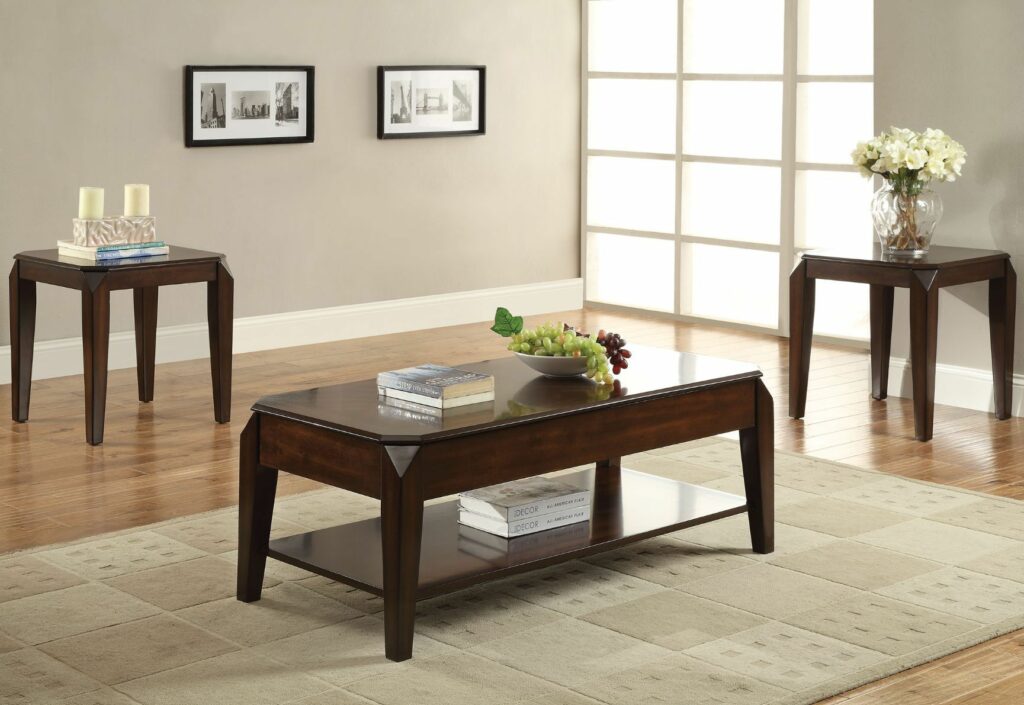
Docila coffee table with lift top by ACME
Coffee Table Size for a Sectional
A sectional changes the math because its total length may be far greater than the part you actually sit on in front of the table. The usual advice is to base the table on the length of the sofa section or longest run, and not on the overall wrap-around footprint. Two-thirds of that longest section is a sensible target, using the same logic as for a straight sofa.
Shape matters more with a sectional. A round or square table suits an L-shaped layout because it can be reached from both arms of the sofa, while a long rectangular table suits a straight run or a chaise section. In a wrap-around layout, measure the open area inside the corner and make sure the table fits there with the same 14 to 18 inches of clearance on each side.
If your sectional is very long, one giant table can overwhelm the room. A popular alternative is to use two smaller tables, or pair a rectangular table with a smaller round one, which also gives guests more places to set a drink. You can compare layouts by browsing our sectional sofas and measuring the section length before you choose the table.
Because sectionals are often deep, a table with a deeper top than usual can look better, as long as you keep the gap in front of it. Choose a height that matches the seat, which on many sectionals sits at the higher end of the typical cushion range.
Choosing a Shape, Finish and Style That Fits
Once you know the size, shape and finish do the rest of the work. Each has a practical effect on how big the table feels in the room.
Round and oval tables
A round table has no corners to bump into, which makes it a favorite for smaller rooms, walkways and homes with children. Diameters of roughly 30 to 42 inches suit most living rooms. It also pairs well with sectionals that wrap around. Browse our round coffee tables if a softer outline appeals.
Light and dark finishes
Color changes how large a piece feels. A light finish tends to recede and feel airy, which can help a larger table sit comfortably in a compact room. A dark finish adds weight and contrast. Take a look at our white coffee tables for a bright, open look, or our black coffee tables when you want a strong, grounded anchor.
Metallic and stone accents
Gold details bring warmth and a classic, formal note that works well with traditional and French-inspired rooms; see our gold coffee tables. Stone tops add visual weight and a sense of permanence, so a marble-topped piece can look larger than its measurements suggest. Explore our marble coffee tables, and remember that heavier-looking materials deserve a little extra clearance.
To compare every shape and finish side by side, browse our coffee tables.
How to Measure Your Room Before You Buy
A tape measure and ten minutes will save you from returns. Follow these steps in order.
- Measure the sofa length. For a sectional, measure the section that faces the table.
- Multiply by two-thirds. This gives your ideal table length. Use one-half as the smallest acceptable size.
- Measure seat height. Take it to the top of the compressed cushion, then subtract 1 to 2 inches for your target table height.
- Measure the open floor. Find the distance between the sofa and the piece that faces it, then subtract 14 to 18 inches on each side to find the maximum depth.
- Mark it out. Use painter’s tape or newspaper to outline the table on the floor. Walk around it, sit on the sofa and see whether your legs and your path feel comfortable.
- Check the route in. Measure doorways, stairwells and hallways so the table can actually reach the room.
If you are still choosing the sofa, buy it first. The coffee table is much easier to match to a sofa than the reverse, and you can browse our sofas to settle on a size before you measure for the table.
Common Coffee Table Sizing Mistakes
Most sizing mistakes come from falling in love with a piece before checking the numbers. Watch for these.
- Going too small. A tiny table in front of a large sofa looks like an afterthought and offers little surface. If you like a small piece, add a second table or a nearby side table.
- Going too big. A table that crowds the sofa leaves no gap and makes the room feel packed. Stay within the 14 to 18 inch clearance.
- Ignoring the seat height. A table taller than the seat feels like a wall. Match or slightly undercut the cushion.
- Forgetting traffic paths. Leave a clear route through the room, not just in front of the sofa.
- Skipping the rug. A rug that does not extend past the table makes the arrangement look unfinished.
- Not checking the product page. Always compare the listed dimensions against your own measurements, and check each product page for exact dimensions before you buy.
A side table can fix a lot of these problems. If the main table must stay compact, a nearby side table adds surface area at the arm of the sofa without enlarging the footprint in the center.
Frequently Asked Questions
What size coffee table should I get?
Start with about two-thirds of your sofa length, a depth of 18 to 30 inches and a height that matches or sits 1 to 2 inches below the seat cushion. For an 84-inch sofa, that points to a table of roughly 56 inches in length. Adjust down for a small room.
How tall should a coffee table be?
Most coffee tables are about 16 to 18 inches tall, which suits the typical seat height of 17 to 19 inches. The best way to find your number is to measure your own cushion and subtract 1 to 2 inches.
How much space should be between the sofa and the coffee table?
Plan for 14 to 18 inches. That leaves legroom while keeping drinks within reach. A snug room can sometimes stretch to as little as 12 inches, while homes with kids or pets often do better near 18 inches.
Should a coffee table be lower than the sofa?
Yes, slightly. A table level with the seat or 1 to 2 inches lower looks balanced and is easy to use. A table far below the seat can be awkward to reach, and one higher than the seat tends to block the view of the sofa.
What size coffee table goes with a sectional?
Base it on the longest section or the section that faces the table, not the whole wrap-around. Aim for about two-thirds of that length. Round or square tables suit L-shaped layouts, and two smaller tables can work better for very long sectionals.
Can a coffee table be too big?
Absolutely. If it leaves less than about 14 inches in front of the sofa, or blocks the main walkway, it is too large. Reduce the length or depth, or switch to a round shape that frees the corners.
What are the standard coffee table dimensions?
Typical guidelines are a height of 16 to 18 inches and a depth of 18 to 30 inches, with lengths that vary to suit the sofa. Round tables commonly measure about 30 to 42 inches across. Treat these as a starting point.
How big should a rug be under a coffee table?
The rug should be larger than the table so that about 6 to 8 inches of rug shows on every side. In most living rooms the front legs of the sofa also rest on the rug, which ties the whole seating group together.
Final Thoughts: Measure Once, Choose With Confidence
The best coffee table is the one that suits your sofa, your room and the way you use it. Start with the simple relationships: about two-thirds of the sofa length, a top 1 to 2 inches below the seat, and 14 to 18 inches of clear floor around it. Then let your taste decide the shape, finish and details, from a crisp round table to a statement marble piece.
When you are ready, browse the full range of coffee tables at Mobilia Cleopatra and compare the listed dimensions with your own measurements. A few minutes with a tape measure now means a table that looks right and feels comfortable for years.
