Free shipping · 0% for 6 months · White-glove available


Italian Leather Furniture Guide: Grades, Tanning and Care

Reviewed by the Mobilia Cleopatra design team
Quick answer: “Italian leather” usually means the hide was tanned and finished in Italy, not that the cows were raised there or that the sofa was built there. The label tells you where the leather was processed; it does not tell you the grade. When you shop for Italian leather furniture, judge the leather grade (full-grain, top-grain, corrected, split, bonded, or “leather match”), the finish, the frame and the cushions, and ask the seller to put those details in writing.
Few materials carry as much prestige in a living room as Italian leather. Many leather sofas, sectionals and recliners lean on the phrase in their names. Yet buyers often discover that two pieces both labeled “Italian leather” feel, wear and cost very differently. The reason is simple: the words describe origin, while quality is decided by the grade of the hide, how it was tanned and finished, and how well the furniture underneath is built.
This guide untangles those layers. You will learn what the label can and cannot promise, how leather grades and finishes differ, what vegetable and chrome tanning mean for a sofa, how to judge a leather piece in a showroom, how to care for it, and where leather beats (and loses to) fabric.
What “Italian Leather” Really Means
Italy has a long history of leather making, and regions such as Tuscany are still closely associated with tanning. That reputation is real, but the term “Italian leather” on a furniture tag is narrower than many shoppers assume. Three separate things can happen in three different countries:
- Where the hides come from. Raw hides are a global commodity. A tannery in Italy may process hides that originated elsewhere in Europe or overseas.
- Where the leather is tanned and finished. This is what “Italian leather” most commonly refers to: the conversion of raw hide into leather, plus dyeing and surface finishing, done in Italy.
- Where the furniture is made. The frame, cushions, cutting and sewing can take place anywhere. A sofa upholstered in Italian-tanned leather is not automatically “made in Italy.”
Two other phrases add to the confusion. “Italian design” or “Italian-inspired” describes a look, typically clean lines, low profiles and tailored seams, and says nothing about materials. “Made in Italy” is a statement about where the finished product was manufactured. If origin matters to you, ask which of these three steps the seller is actually describing.
It also helps to know that the label is not a grade. A high-end full-grain hide and a heavily corrected, pigment-coated hide can both come out of an Italian tannery. U.S. Federal Trade Commission guides for leather goods, written for items like handbags, luggage and footwear rather than furniture specifically, set out the same principle: materials that only look like leather, or that are made from ground leather fibers, should not be passed off as leather without clear disclosure (16 CFR 24.2). For furniture, the practical takeaway is to look past the country name and read the material description.
At Mobilia Cleopatra, some sets are described on their product pages as upholstered in top-grain Italian leather, for example several pieces in GU Furniture’s DivanItalia collection, which you can browse among our Italian living room furniture sets. As with any piece, the product page is the place to confirm the grade, materials and dimensions.

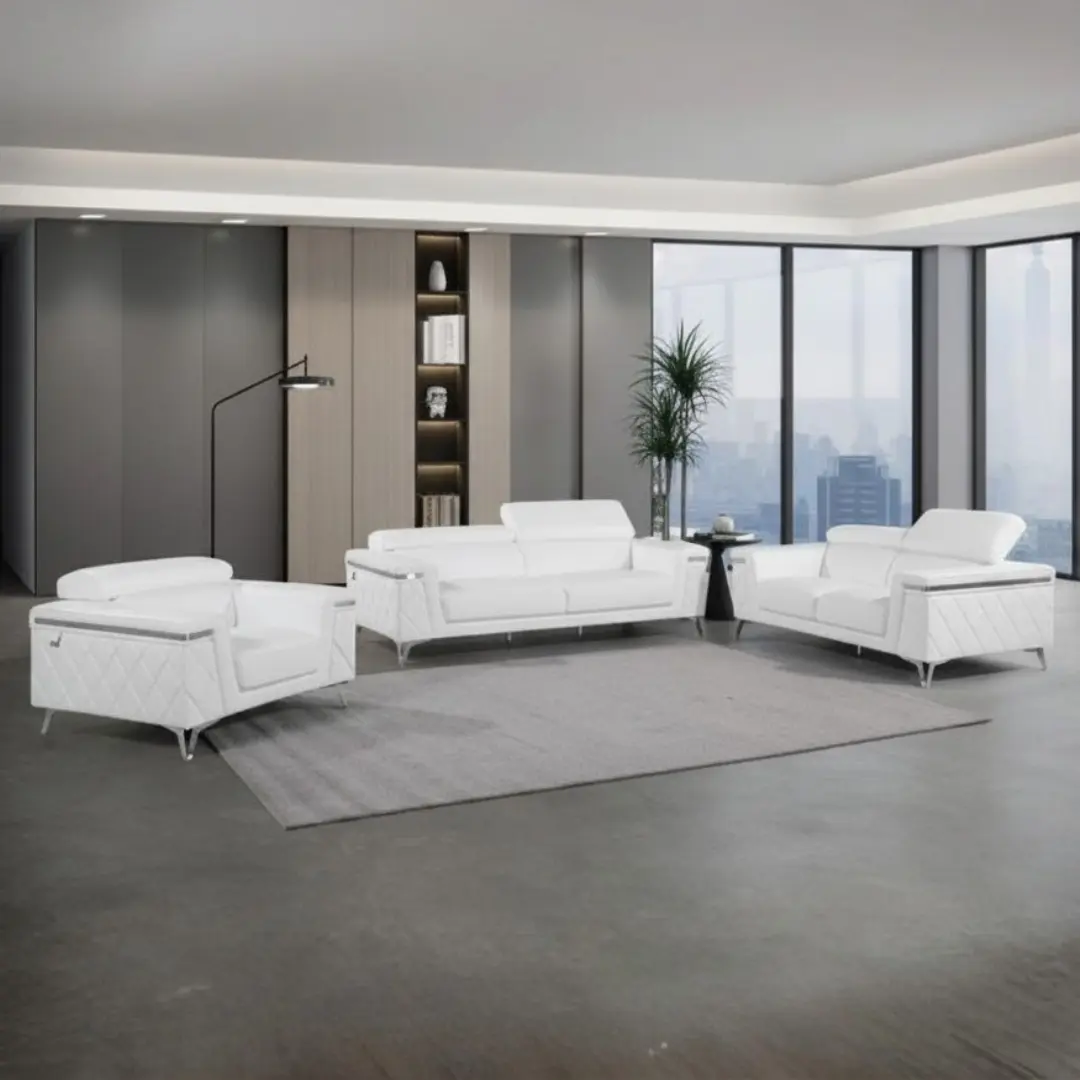
Stylish Italian leather furniture designed for contemporary interior spaces
Leather Grades: Full-Grain, Top-Grain, Corrected, Split and Bonded
A cowhide is thick, so tanneries split it into layers. The outer layer carries the grain, the tight, durable surface with the hide’s natural pores and markings. The lower layers are looser and weaker. Where a piece of upholstery comes from in that stack, and how much its surface has been altered, defines its grade.
Full-grain leather
Full-grain leather keeps the complete outer surface of the hide. Nothing is sanded away, so natural marks such as small scars, wrinkles and variations in the pores remain visible. It is the strongest and most breathable grade and develops the deepest patina over time. Because only the best hides are clean enough to be used this way, full-grain upholstery is the most expensive option.
Top-grain leather
Top-grain leather also comes from the outer layer, but its surface has been lightly sanded or buffed to soften blemishes, then finished for a more even look. It remains genuine grain leather with good strength, and the more uniform surface is easier to keep clean. Most quality leather sofas and recliners use top-grain leather on the main surfaces; it is the grade named on several DivanItalia product pages.
Corrected-grain leather
Corrected grain starts with a hide whose surface had too many flaws. It is sanded more heavily, embossed with an artificial grain pattern and coated with pigment. The result is very uniform and stain resistant, which suits busy households, but it feels less natural, breathes less and does not develop much patina.
Split leather
Split leather comes from the lower layers left after the grain is removed. It is real leather but weaker, so for upholstery it is usually coated and embossed to look like grain leather, or it is used on less visible areas. Suede is a split leather with a napped surface.
Bonded leather
Bonded leather is made from leather scraps or fibers mixed with binders and pressed onto a backing, usually with a polyurethane surface. It is the least durable option, and the surface can peel over time. Under the FTC leather guides, the leather-fiber percentage should be disclosed when the term is used.
“Leather match”
“Leather match” (sometimes “L/M”) is not a grade of hide but a construction method. Genuine leather, usually top-grain, covers the areas you touch, such as seat cushions, backrests and arm tops, while the outer sides and back are covered in a color-matched synthetic or lower-grade material. It lowers the price, but the two materials can age differently. If a tag says “leather match,” ask exactly which surfaces are leather.
For how these grades play out on large L-shaped and modular pieces, see our guide to leather sectional living room ideas.
Aniline, Semi-Aniline and Pigmented Finishes
Grade tells you which part of the hide you are buying. Finish tells you what was done to its surface, and it shapes how the leather looks, feels and lives day to day.
- Aniline leather is dyed all the way through with transparent dyes and has little or no protective topcoat. It shows the natural grain most clearly and feels the softest and warmest, but it absorbs spills, marks easily and fades in strong sun. Only high-grade hides are finished this way, so it is usually full-grain.
- Semi-aniline leather is dyed through and then given a light protective coat that may contain a little pigment. It keeps much of the natural character while resisting stains and fading better than aniline. Many people consider it the best balance for a family sofa.
- Pigmented (protected) leather has an opaque, pigment-based surface coating. Color is even, and the leather is the easiest to wipe clean and the most fade resistant. The trade-off is a cooler, less natural hand and less patina. Corrected-grain leather is almost always pigmented.
A simple showroom test: press a fingertip into the surface. Aniline leather usually shows a slight color change and wrinkles naturally around your finger; pigmented leather barely changes. Some retailers also allow a small water-drop test on a sample. A drop that darkens and soaks in suggests aniline; a drop that beads up suggests a protective finish.
When you compare “Italian leather” sofas, the finish often explains more of the price difference than the country of origin.

High-end Italian leather furniture
Vegetable Tanning vs. Chrome Tanning
Tanning is the chemistry that turns a perishable raw hide into stable leather. Two families of methods dominate, and both are used in Italy.
Vegetable tanning uses tannins from plant matter such as bark, leaves and wood. The Canadian Conservation Institute describes it as tanning with “tannin-rich vegetable matter (bark, leaves, twigs) in water,” usually followed by oils or fats worked in for flexibility (CCI Note 8/2). It is a slow process. Vegetable-tanned leather tends to be firmer, carries an earthy scent and darkens into a rich patina. Tuscany in particular is known for it, and it is common in belts, bags, shoes and structured leather goods.
Chrome tanning is a form of mineral tanning that uses chromium salts. It is much faster, and the CCI notes that mineral-tanned leathers have high moisture resistance. Chrome-tanned leather is typically softer, more pliable and takes bright, consistent colors well. Those qualities explain why most furniture upholstery leather, including much of what is sold as Italian leather, is chrome tanned or uses a combination of methods.
What does this mean for a sofa buyer?
- A soft, drapey, evenly colored leather on a cushioned sofa is most likely chrome tanned or combination tanned. That is normal and not a sign of low quality.
- Vegetable-tanned upholstery exists but is less common. It suits buyers who want a firmer hand and pronounced aging and who accept more care.
- Tanning method and grade are separate questions. Full-grain leather can be chrome tanned, and a vegetable-tanned hide can still be a lower grade.
If a seller makes environmental claims about a tanning method, ask for specifics, such as which tannery and which certification, rather than accepting a general statement.
How to Judge an Italian Leather Sofa Before You Buy
The leather is the part you see, but a sofa is only as good as everything under it. Use this checklist in a showroom or when reading a product page.
Ask about the leather
- Grade: Is it full-grain, top-grain, corrected, split or bonded?
- Coverage: Is the whole piece leather, or is it leather match? Which surfaces?
- Finish: Aniline, semi-aniline or pigmented?
- Origin: If “Italian” matters to you, is that where the leather was tanned, where the furniture was built, or the design style?
Look and touch
Genuine grain leather shows small, irregular pores and slight natural variation; a perfectly repeating pattern often signals embossing. Check the cut edges where visible: real leather shows a fibrous edge, while bonded or synthetic material shows a fabric backing. Run your hand across panels to see whether texture and color stay consistent from seat to back, which can reveal leather match.
Check construction and comfort
- Frame: Solid or kiln-dried hardwood frames hold up better than particleboard. Lift one front corner a few inches; a sturdy frame lifts without twisting.
- Stitching: Seams should be straight and even, with no loose threads or puckering at the corners.
- Cushions: High-resilience foam recovers quickly after you stand up. Ask what is inside the seat and back cushions.
- Fit: Sit for several minutes. Check seat depth, back height and arm height against how you actually relax.
- Mechanisms: On reclining pieces, operate every mechanism and listen for grinding.
Our guide on how to identify high-quality furniture goes deeper into frames, joinery and finishes. When you are ready to compare, browse our sofas and reclining chairs and sofas and read the material details on each product page.

Italian leather furniture collection
Styling Italian Leather Furniture in Modern and Traditional Rooms
Leather adapts to many styles, and the finish and silhouette decide which. In a modern room, a low, clean-lined sofa in black, gray or white top-grain leather pairs well with stone or glass tables, slim metal accents and a restrained palette. Matte and semi-aniline finishes read softer and warmer than glossy pigmented leather.
In a traditional room, tufting, rolled arms, nailhead trim and warm cognac, brown or deep oxblood tones connect leather to wood paneling, carved details and patterned rugs.
Leather also benefits from contrast. Velvet accent chairs, wool throws and linen curtains soften its smooth surface, and a textured rug keeps a large leather sofa from feeling heavy. If you are weighing soft, plush upholstery against leather, our guide to velvet furniture covers how that fabric behaves. Coordinated living room sets make it easier to match sofa, loveseat and chair, while mixing one leather sofa with fabric living room chairs creates a more layered look.
Caring for Leather Furniture
Leather is durable, but it responds to light, heat and humidity. Start with the manufacturer’s care instructions, because the right products depend on the finish. These widely accepted basics apply to most leather furniture:
- Dust regularly with a soft, dry cloth or a soft brush attachment on a vacuum.
- Blot spills right away with a clean, absorbent cloth. Do not rub, and avoid soaking the leather with water.
- Use only leather-specific cleaners suited to your finish. Skip household detergents, solvents, ammonia and furniture polish.
- Test first. Try any cleaner or conditioner on a hidden spot and let it dry before using it on visible areas.
- Keep it out of direct sun. Sunlight fades leather, especially aniline. Conservation guidance also advises keeping leather away from strong light.
- Keep it away from heat sources. Heating vents, radiators and fireplaces dry leather out and can lead to cracking.
- Avoid extremes of humidity. Conservators note that very dry air causes embrittlement and very humid air encourages mold, so a steady indoor climate is best.
- Condition sparingly. Follow the manufacturer’s schedule. Too much product can leave residue or darken aniline leather.
For ink, grease, deep stains or tears, contact a professional leather cleaner rather than experimenting. The easiest care plan, though, starts at purchase: choosing a finish that suits your household. If you want to select the upholstery, color and configuration yourself, explore our options to design your own furniture.

Modern Italian leather furniture
Pros and Cons of Italian Leather Furniture
Leather is not the right choice for every home. Weigh these points honestly before you buy.
| Pros | Cons |
|---|---|
| Genuine grain leather is strong and resists tearing. | Quality leather costs more than most fabrics. |
| Spills on protected finishes wipe off easily. | Aniline leather stains, scratches and fades easily. |
| Does not trap dust and pet hair the way fabric can. | Pet claws can scratch or puncture the surface. |
| Full-grain and top-grain leather develop an attractive patina. | Can feel cool in winter and warm or sticky in summer. |
| Works in modern, transitional and traditional rooms. | Needs protection from sun and heat. |
| Softens with use rather than looking worn out. | Labels like “Italian leather” or “leather match” can hide lower grades. |
For many households, a top-grain, semi-aniline or pigmented leather sofa offers the best mix of looks and practicality. If you have cats or young children and want a very natural look, consider protected leather or a durable performance fabric instead.

Modern luxury Italian leather furniture
Frequently Asked Questions
Is Italian furniture leather better than other leather?
Not automatically. Italian tanneries have a strong reputation, but “Italian leather” describes where the hide was tanned and finished, not its grade. A top-grain or full-grain leather from any reputable tannery can outperform a corrected or bonded material with an Italian label. Compare grade, finish and construction first.
What does “Italian leather” mean on a sofa tag?
It usually means the leather was tanned and finished in Italy. It does not necessarily mean the hides came from Italian cattle or that the sofa itself was made in Italy. “Italian design” or “Italian-inspired” refers only to the style.
Is Italian leather real leather?
It should be, but check the full material description. Genuine options include full-grain, top-grain, corrected-grain and split leather. Bonded leather contains leather fibers but is a reconstituted material, and leather match combines leather with a matched synthetic on some surfaces.
What is the difference between full-grain and top-grain leather?
Full-grain leather keeps the entire natural surface of the hide, including small marks, and develops the deepest patina. Top-grain leather has its surface lightly sanded and finished for a more even look and easier cleaning. Both are strong, quality grades for furniture.
Is “leather match” real leather?
Partly. The surfaces you sit on and touch are usually genuine leather, often top-grain, while the outer sides and back use a color-matched synthetic or lower-grade material. Ask the seller which panels are leather.
Does Italian leather scratch easily?
It depends on the finish, not the country. Aniline leather marks easily, though light scratches often blend in as part of the patina. Semi-aniline and pigmented leathers have a protective coating that resists everyday scuffs better.
Is an Italian leather sofa worth the money?
It can be if you buy for grade and construction rather than the label. A top-grain or full-grain leather on a solid frame with resilient cushions usually ages well. Paying extra for the word “Italian” alone, without knowing the grade, is rarely good value.
Choosing Italian Leather Furniture with Confidence
Italian leather deserves its reputation, but the label is only the starting point. The questions that predict how a sofa will age are about the hide and the build: Is it full-grain, top-grain or something lower? Is it aniline, semi-aniline or pigmented? Is the whole piece leather, or only the seating surfaces? What frame and cushions sit underneath?
Once you know those answers, the choice becomes personal. If you love a natural surface that records its history, look for full-grain or aniline leather and plan to care for it. If you want an easy-living family sofa, top-grain leather with a protective finish is a practical choice. Either way, match the color and silhouette to your room and soften the look with textiles.
To compare options, browse our Italian-styled sets, sofas and recliners online and check the material details on each product page, or see pieces in person at our Upland showroom at 280 N Benson Ave, Suite 6, Upland, CA 91786. Our team is happy to answer questions about specific pieces at (909) 999-1442.
